A few weeks ago I wrote about cameras. About the way we turn them on our own situations, the way the act of watching replaces the act of moving, the way the angle becomes the anesthetic and the frame becomes the freeze. I thought that was the problem. I was satisfied with that. I had named the disease, prescribed maintenance over narrative, told you the dishes are just dishes and the leak is just a leak, and I walked away from the keyboard feeling like I had solved something.
I had not solved something.
I had solved the outer layer of something and mistaken it for the whole thing, which is exactly the kind of move I was warning against, which means the essay about self-deception was itself a form of self-deception, and if you think that’s funny, you’re right, it is funny, and I am only now catching up to the joke.
You can turn off the camera. You can refuse the noir filter, reject the political drama, stop treating your paralysis as content. You can do all of that and still be stuck. Because even when you stop framing the external situation, you’re still standing in the wrong part of the room. You just can’t tell, because the lights are finally on and you assumed that was enough.
It wasn’t enough.
I know this because three things I wrote recently circled the same drain without any of them going down it. The first was about my persona online. I had been selling shadow for months. Dark observations, bitter edges, the kind of content that pulls engagement because it gives people something to push against. Then I announced I was going to lighten up. Not gradually. Publicly. Like a man standing on a stage telling the audience he’s about to change the play they paid to see.
The metrics collapsed within forty-eight hours.
My first read was that audiences are fickle. That they wanted the darkness and rejected the light. That the mask was a trap I couldn’t escape without losing everything I’d built. This interpretation let me feel like a victim of my own success, which is a very comfortable feeling, like a warm bath with a view, and I sat in it for a while before I noticed the water was getting cold.
The mask wasn’t costume. The mask was architecture. I had built a structure my audience was living inside, and then I demolished it without warning. They didn’t leave because they rejected my happiness. They left because the building fell down. I thought I was the face behind the mask. I was the structure the face lived inside. Different thing entirely. The face is replaceable. The structure is what everyone was standing on.
The second piece was about education. About deaths of despair and the boys falling through cracks that keep getting described as temporary but have been there long enough to develop weather patterns. The argument traced a line from mortality statistics to a single variable: whether someone got the cognitive architecture that makes agency possible. Not the degree. The operating system underneath the degree. The ability to hold a goal across time and navigate toward it despite the fact that everything is on fire and the fire started itself and nobody is coming.
We talk about education as credential. Sorting mechanism. Class marker. But the actual function, when it works, is the installation of an operating system. Executive function. Impulse control. The capacity to see a future you might affect. Kids aren’t failing because they lack credentials. They’re failing because the OS never got installed, and we keep troubleshooting the applications while the hard drive spins in the dark.
The third thing was about death. Not the final one. The constant one. The dissolution of moments passing, the versions of yourself that ended without ceremony, the background hum of loss that sits underneath everything like hold music you forgot you were listening to. The frame we apply to this is grief. Or failure. Or the sense that something essential is being taken from us, that we are diminishing, that each cut removes something we needed.
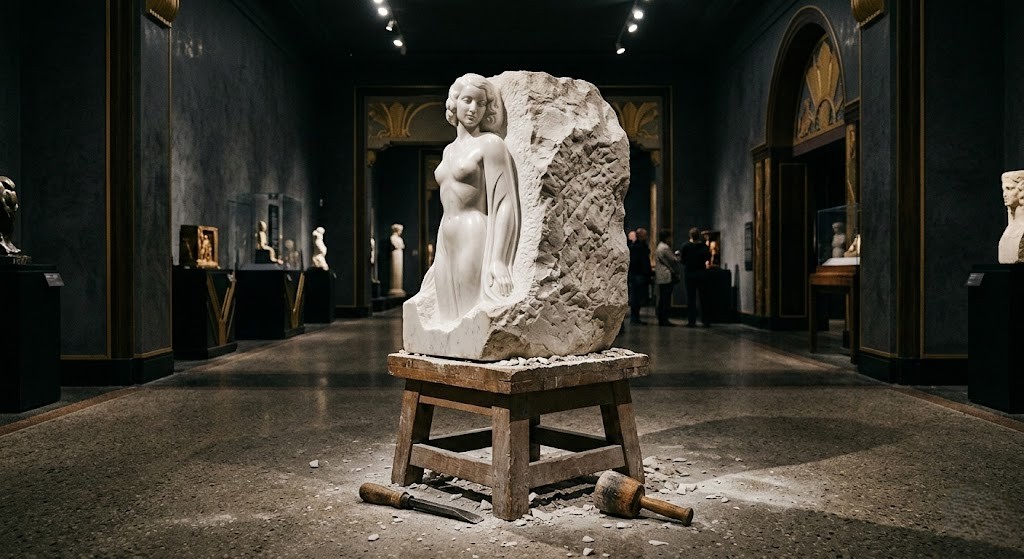
But the sculptor doesn’t mourn the marble on the floor. The carving reveals the shape. The shape was always there, waiting to be uncovered by the removal of everything that wasn’t it.
I thought I was the thing being diminished. I might be the thing being revealed. That sentence landed differently than I expected when I wrote it.
Three pieces. Three versions of the same mistake. I located myself in the face instead of the architecture. In the credential instead of the capacity. In the marble instead of the form. Every time, I pointed at the visible thing and said “that’s me” and every time the visible thing was the part that was supposed to fall away.
I don’t have a clean answer for this. I had one for the camera problem. Stop filming. Do the dishes. But this is different. This is the part where you’ve already stopped filming and you’re standing in the room with the lights on and your hands empty and you realize you’ve been mourning the wrong thing. You’ve been grieving the marble. The marble was never you. The marble was what was in the way.
Maybe the answer is temporal. The material is what you were. The shape is what you’re becoming. Maybe the answer is attentional. You can’t see the shape directly, but you can feel its edges by noticing what’s being removed, the way you can feel wind by what it moves through. Maybe the answer is faith. Not the religious kind. The structural kind. The belief that removal is revelation rather than destruction.
I don’t know which one is right. I wrote an entire essay a few weeks ago with the confidence of a man who had figured something out, and it turns out I had figured out the lobby and mistaken it for the building. So I am doing the honest thing here, which is admitting that the map I drew last time was accurate but incomplete, and the territory keeps going, and I am still walking, and the marble is still falling, and I am trying very hard to believe it’s supposed to.
 The Hofflebrock
Leave a comment