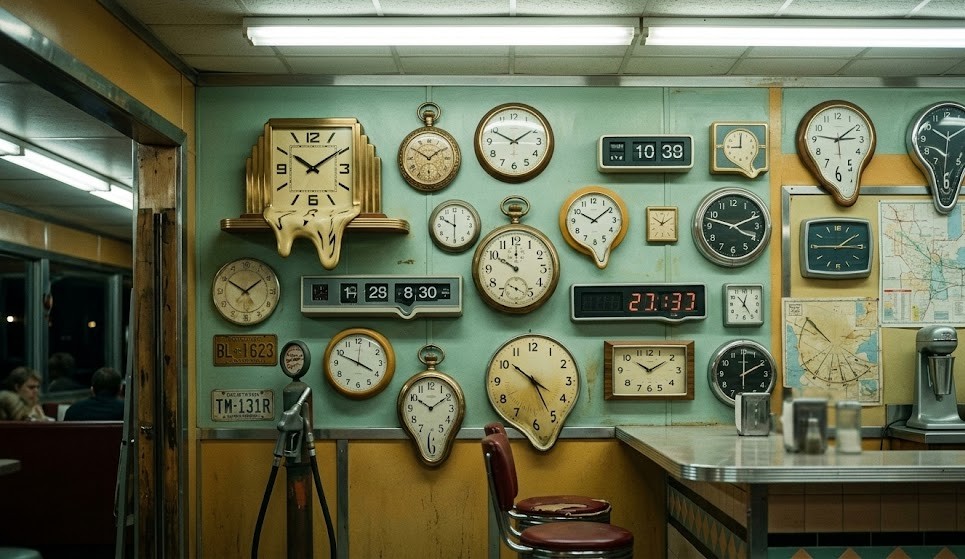
I lost February. I don’t mean it was short. I mean it left. One moment I was standing inside it and the next I was standing in March wearing the same pants and holding a coffee that had gone cold during a month I apparently attended but cannot account for. January, I remember. January lasted eleven years. Every week in January was a geological epoch. I aged visibly between Mondays. I developed opinions about oatmeal. I watched the same four walls perform a one-man show about endurance and I gave it three stars because it had no intermission. January was the kind of month that makes you check the calendar and then check it again because surely more time has passed than that, surely you have suffered enough for it to be at least April.
And then February started, and I blinked, and the blink had a month inside it, and now I’m here.
Does anybody really know what time it is?
I asked this at a gas station. The man behind the counter looked at me like I had asked him to explain the moon. Which, fair. But I wasn’t being philosophical. I was being practical. My phone said 2:14. The clock on the wall said 3:07. The receipt said 1:58. Three machines in the same room, all powered by the same electrical grid, all connected to the same satellites, and not one of them could agree on when it was. This is the infrastructure. This is what we’ve built. A civilization of clocks that cannot keep time, arguing with each other on your behalf while you stand there holding a bag of peanuts and wondering if the afternoon has already happened or if it’s still pending.
You don’t know what day it is either. I know you don’t. I can tell by the way you looked at your phone just now. You looked at it the way you look at a friend who owes you money. You looked at it hoping it would tell you something you could use and it told you a number and the number meant nothing. Wednesday. Is it Wednesday? It feels like Wednesday. It also feels like Friday and like a Sunday that got lost and ended up in the middle of the week wearing someone else’s name. The days are not organized. They are a drawer full of socks that used to match and now you just grab two and hope nobody looks down.
I had a meeting yesterday. Or the day before. The meeting was about the future. Everyone in the meeting was very concerned about the future. They had slides. The slides had timelines. The timelines had quarters and the quarters had goals and the goals had deadlines and every single person in that room was pretending they knew what month it was. I sat there nodding. I have gotten very good at nodding. Nodding is the only skill that transfers across all temporal zones. You can nod in January. You can nod in whatever we’re calling this. You can nod at a gas station at a time that three different clocks cannot agree on and the nod still works. The nod is the universal constant. Not the speed of light. The nod.
The slides said Q2. I wrote down Q2. I underlined it. I do not know when Q2 is. I know it comes after Q1 the way Wednesday comes after Tuesday, which is to say technically, on paper, in a system that somebody designed and the rest of us pretend to inhabit. But the system is drunk. The calendar is a suggestion that got laminated and hung on a wall and everyone agreed to take it seriously and nobody asked why. We all walk around carrying the same twelve-month hallucination and getting upset when it doesn’t match the way time actually feels, which is: January is a prison sentence. February is a rumor. March is the moment you realize you’ve been holding your breath and you don’t remember starting.
The world may explode at any second and you’re still talking about tomorrow.
That’s the part I can’t get over. The future tense. We use it constantly. We use it like it’s a place we can visit, like it’s a room at the end of the hall that we’ll get to eventually if we keep walking. “I’ll do it tomorrow.” “We’ll revisit this next quarter.” “Let’s circle back.” Circle back. As if time is a loop you can reenter. As if the meeting you missed is still happening somewhere and you just need to find the right hallway. The future tense is the biggest bluff in the language. It is a check written on an account that may or may not exist by the time the check clears, and we write them constantly, dozens a day, convinced that the bank will still be open tomorrow, which is itself a future-tense proposition, which means the whole operation is a pyramid scheme running on grammar and good faith.
I got home. It was dark. It is always dark when I get home now, or it is still light, and the difference between those two things is a season I cannot locate on the calendar because the calendar and I are no longer speaking. I sat on the couch. I looked at my phone. My phone said it was a time. I chose to believe it. Not because I trusted it but because the alternative is standing in a gas station asking a stranger to explain the moon and I have already done that once this week. Or last week. Or during that part of February that apparently happened while I was blinking.
The coffee is cold again. It keeps doing this. I keep making it hot and it keeps becoming cold and the process by which it transitions from one to the other is called time and I am beginning to suspect that time is not a force or a dimension or a river or any of the metaphors we use to make it behave. Time is a gas station clerk who doesn’t know the answer either but has to say something because you’re standing there, holding peanuts, waiting.
 The Hofflebrock
Leave a comment