The Hofflebrock

  • June 17 – Longevity

    Heat, AI, and the Measured Edge

    In the biotech and longevity arena yesterday, the conversation sharpened around what actually moves the needle inside one body versus population averages, with n=1 data, AI clinical scaffolding, and preventive levers taking center stage.

    Bryan Johnson delivered the most granular signal of the day: a 56-minute 200°F dry sauna session tracked via ingestible core temperature capsule. Benefits tied to time above 102.2°F threshold for HSP27 activation—not arbitrary minutes. Ice on face, neck, and groin extended tolerable exposure but delayed the core response; HR peaked 128–133 bpm. Separate beds with Kate for sleep optimization also surfaced, backed by mixed studies on partner-induced awakenings versus subjective gains. Johnson framed n=1 experimentation as essential complement to RCTs, citing first-in-human observations on toxin clearance and microplastics elimination. Immortals pushes “radical” cultural entry points to accelerate collective survival responsibility.

    Eric Topol spotlighted emerging AI agents capable of end-to-end post-ED care and longitudinal outpatient management—new capability thresholds in two Nature papers. Spatial human proteomics (>13k proteins, thousands of samples across tissues and cancers), resistance training’s additive CVD benefit in women, heat shock proteins as resilience buffers for pathogenic mutations, and shingles vaccination’s dementia risk reduction (fresh large-cohort data joining prior natural experiments) rounded out the literature pulse. Unexpected GLP-1 signals on violent crime reduction noted in passing.

    Investment moves from a16z reinforced the AI-clinical bridge: Telepatia’s $33M Series A for AI scribe/decision support/auditor platform live across Latin American hospital systems, and Convey’s $38M for non-technical AI teammates that automate operational workflows via screen-sharing onboarding. Formation Bio’s CEO commentary underscored clinical development as the durable bottleneck amid abundant discovered molecules.

    Charles Brenner connected shingles vaccine benefits to latent varicella’s impact on brain resilience and endorsed continued viral targeting as anti-aging medicine. He highlighted mutational meltdown in serial mouse cloning as cautionary data on epigenetic reprogramming limits—Muller’s ratchet in action. Aubrey de Grey congratulated Gero’s funding progress toward preclinical aging therapeutics. Salim Ismail nodded at AI democratization shifting advantage from frontier models to execution systems. Peter Diamandis hammered education’s mismatch with an AI-abundant world—memory testing amid infinite recall, collaboration punished as cheating—and reminded that longevity breakthroughs anywhere benefit everyone due to shared biology. Historical reframing: a century ago, infection, childbirth, and bad winters defined the survival baseline.

    Matt Kaeberlein bridged the realism gap: tools exist and more are coming, yet the aggregate trajectory does not yet project conquering aging in our lifetimes—combination data remains thin.

    Taken together, the day’s feed sketches a sharpening operational edge: measure your own heat dose, deploy AI for care and ops at scale, leverage accessible preventives like shingles vaccination, and rebuild systems (education, culture) for execution in an age of accelerating breakthroughs. The signal is concrete, individualized, and infrastructure-aware—less speculation, more protocol.

  • June 17 – Markets

    Fed Says “Inflation Is a Choice” While the Dots Go Full Hawk

    Fed communications under new Chairman Kevin Warsh marked a sharp pivot. The dot plot showed nine of 18 officials projecting at least one rate hike this year, with six of those forecasting multiples; only one projected a cut and Warsh submitted no SEP. The statement underwent a full rewrite, shorter, with repeated emphasis on delivering price stability. Warsh described inflation as a choice the FOMC is going to fix after missing for five years. Markets registered the shift: bond pricing moved from two cuts to two hikes at the start of the year, a roughly 1% swing, with the 2-Year Treasury yield closing at 4.21% after starting the year at 3.48%. Likelihood of a July hike jumped sharply per CME data. Atlanta Fed GDPNow nowcast for Q2 rose to +3.0%. Year-ahead business inflation expectations edged down slightly to +2.3%.

    Zerohedge reported on the Trump-Iran MOU signed ahead of schedule, with Iran confirming terms including no US troop boosts or new sanctions for 60 days and US responsibility to enforce Israeli compliance. Separate items covered UAE efforts to achieve zero Hormuz dependency by rewiring energy flows, a fire at a major Southern California food storage warehouse, Korean banks seeing 10-year high demand deposit turnover as investors shift liquidity toward stocks, a US Embassy jet ski warning in the Bahamas, and states starting to register panic over AI taking over.

    In AI commentary, Chamath Palihapitiya highlighted an NYT essay questioning why AI makers continually warn of world-ending risks, noting it won’t happen. He also flagged rapid progress in open-weight models, with GLM-5.2 jumping to first on Design Arena benchmarks and closing gaps on closed-source systems; recursive RL expected to shrink deltas further toward convergence. David Sacks pushed back on narratives downplaying his stance on Anthropic’s Mythos cyber preview, clarifying he treated the threat as real and urged immediate hardening of systems and patching while critiquing scare tactics. Chamath additionally touted his current team as the best he has recruited—based, cracked, humble, wicked smart, honorable—with many rising from interns—and promoted 8090’s Software Factory as an emerging enterprise control plane.

    Other notes: Intel trading at extremes (over 11x sales today versus under 2x a year ago, over 100x expected profits despite recent losses). Profplum99 shared parenting advice on building an affection reservoir between ages 2-12. Ray Dalio reminded that any single dot is one data point from one moment and should not be overweighted. Charlie Bilello underscored that promises of money-market stability with market-leading returns do not exist and that higher returns carry higher risk.

    No qualifying posts from biancoresearch, RobinBrooksIIF, morganhousel, LynAlden, or HowardMarks.

  • June 17 – Geopolitics

    Institutional Rot, Great Power Reckonings, and the Credal Nation

    June 17 brought into sharp relief the recurring themes that define geopolitics and great power strategy discussions: the catastrophic failures of Western institutions to protect their most vulnerable, the messy realities of great power diplomacy, and the persistent tensions over what constitutes national identity in a diverse, high-stakes world.

    At the center was the horrifying scale of the UK grooming gangs scandal. Samo Burja described it plainly as the worst human rights abuse of citizens by any developed government in the 21st century: government institutions enabled and covered up the organized abuse of over 250,000 underage victims over decades. Razib Khan amplified the point with references to the banality of evil, official denial, and class dynamics that allowed the crimes to persist. The failure was not mere oversight but active institutional protection of perpetrators at the expense of British girls, underscoring a profound breakdown in elite accountability and civilizational self-preservation. Calls for responsibility and an end to censorship and propaganda around the issue highlighted the depth of the betrayal.

    Parallel to domestic institutional failure came the contested US-Iran framework. Noah Smith framed developments as a stunning display of Trump administration incompetence—worse than Bush’s mishandling of Katrina—pointing to Iranian tankers bypassing blockades and a deal that appeared to legitimize a regime long viewed as adversarial. Posts captured skepticism toward characterizations of Iranian leadership as rational actors, alongside Richard Hanania’s caution against overinterpreting financial elements like frozen funds and reconstruction commitments. The episode illustrated the risks and trade-offs in great power dealmaking, where short-term optics clash with long-term strategic consequences in energy markets and regional stability.

    Running through the conversation were deeper debates on identity, immigration, and national character. Noah Smith emphasized that Americans consistently view the United States as a credal nation—defined by ideas rather than race or religion—dismissing certain right-wing ethnonationalist framings as fringe and broadly unpopular. Razib Khan engaged on the nuances of “Heritage American” concepts, mixing trends in the Southwest, and reactions to polling that challenge progressive assumptions. Richard Hanania offered a counterpoint rooted in elite experience: high-skill immigration succeeds because talent encounters (such as Dwarkesh Patel’s path) reveal the arbitrariness of birth circumstances, contrasting this with broader societal attachments to superficial traits. He also noted progress on housing abundance in places like Texas as evidence that pragmatic governance can cut through ideological gridlock.

    Additional threads touched on regulatory absurdities, such as California’s preferences for LGBT-owned firms in utility contracts, and observations on China’s civilizational effectiveness despite governance shortcomings. Technology and battlefield realities, including drones, received passing nods amid broader strategic discussions.

    Collectively, this paints a picture of institutional fragility meeting great power friction. Societies that fail to safeguard their children while pursuing ambitious diplomatic resets expose deep vulnerabilities. At the same time, debates over credal versus ethnic definitions of nationhood, the value of selective talent flows, and pragmatic policy wins reveal ongoing contests over how open, effective societies should define and sustain themselves. The signal is clear: accountability for past failures and clear-eyed realism about civilizational trade-offs will determine whether these pressures lead to renewal or further erosion.

    Institutional Credibility, Great Power Diplomacy, and Strategic Priorities

    The conversation highlighted ongoing strains in transatlantic relations, US foreign policy accountability, and the complexities of Middle East diplomacy amid shifting energy and security dynamics.

    Ian Bremmer critiqued the Iran framework as ultimately landing on President Trump’s desk for credit or blame, noting it is neither solely Netanyahu’s conflict nor Vance’s peace initiative. He emphasized US priorities of reopening the Strait of Hormuz and restoring oil flows, while recalling earlier allowances for Iranian oil sales. Posts also touched on broader G7/G-Zero dynamics and challenges in US-China positioning, with graphics showing both powers lagging in certain global metrics.

    Michael Kofman shared interest in technical analyses of Russian systems like the Oreshnik missile, pointing to reported guidance vulnerabilities and manufacturing shortcuts under political pressure.

    Elbridge Colby and others in the orbit remained relatively quiet in the window, underscoring a moment of reflection on deal implementation, institutional trust, and long-term strategic positioning rather than immediate escalation. The overall tone reflected measured skepticism toward rapid diplomatic wins, with focus on verifiable outcomes in energy security and alliance cohesion.

    This snapshot underscores the tension between short-term tactical gains in contested regions and the deeper requirement for credible, consistent great power strategy.

    Strategic Realignments, Technological Sovereignty, and Battlefield Evolution

    This discussion emphasized European efforts to assert technological and defense independence, local democratic mechanisms in China, and the shifting realities of modern warfare driven by drones and precision systems.

    Arnaud Bertrand highlighted positive developments in French intelligence moving away from Palantir toward domestic alternatives, framing it as a long-overdue step toward sovereignty. He also detailed local democratic oversight in China, where a Zhejiang district people’s congress voted down major government investment projects, illustrating genuine bottom-up checks on spending at the local level.

    Kamil Kazani offered historical parallels on political loyalty and institutional resilience, drawing from Roman examples of principled support coming from newer or outsider elements.

    Trent Telenko focused on military-technical shifts, noting European vulnerabilities in missile, drone, and interceptor inventories compared to Russia’s capabilities. He discussed adaptations in Ukrainian armor against drones, evolving tank roles away from direct assault, and potential efficiencies in munitions like winged JDAM-ER for bunker-busting. Commentary also touched on Russian systems like Oreshnik facing guidance and manufacturing issues under pressure.

    The collective signal points to accelerating pushes for strategic autonomy in Europe, functioning local governance experiments elsewhere, and the drone-dominated attrition dynamics reshaping conventional military power. These threads underscore a world where technological sovereignty, institutional adaptability, and battlefield innovation increasingly determine great power outcomes.
  • Operator Prediction

    June 13, 2026

    Prediction 1

    A Major Crisis or Crackdown at the Top AI Within

    the next six months, the leading companies building the most advanced AI models will face severe consequences due to how powerful their new systems have become. We will likely see extreme government intervention, a forced breakup of a major AI company, or the dramatic firing of top tech executives.

    Prediction 2

    An AI Financial Crash Driven by Resource Before

    the end of 2026, the AI industry will experience a “dot-com” style financial bubble burst. Many heavily funded, medium-sized AI startups will go bankrupt simply because they cannot secure the massive amounts of electricity and computer hardware required to run advanced AI. Only giant tech monopolies and government-funded projects will have the resources to survive.

    Prediction 3

    Tech Leaders Will Fully Merge AI with Political By

    2027, the creators and leaders of the AI industry will abandon the appearance of being politically neutral tech builders. Instead, they will openly use their wealth, social media platforms, and AI systems to push specific political ideologies, entirely blurring the line between technology business and political activism in order to bypass traditional media and government institutions.

  • Chamath

    Chamath

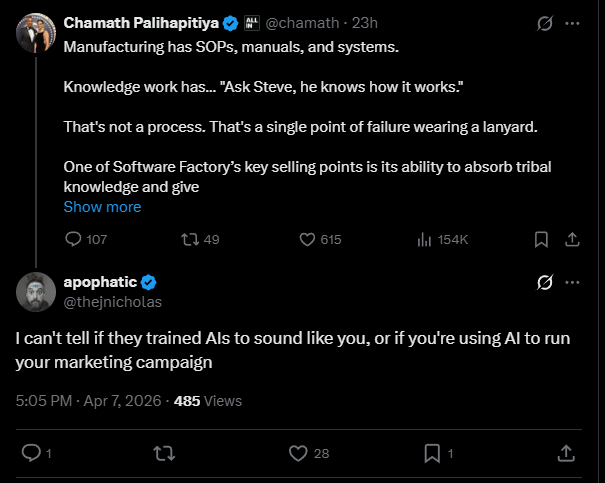
    I was three scrolls into an X session I had already promised myself I wouldn’t have when Chamath Palihapitiya appeared on my screen and said something about manufacturing having SOPs and knowledge work having Steve, and Steve is a single point of failure wearing a lanyard, and I stopped scrolling because the sentence sounded like something I had heard before. Not the content. The shape. The way each paragraph did exactly one thing and then stopped and the next paragraph did one thing and then stopped and the rhythm was declaration, pause, pivot, sell. Declaration, pause, pivot, sell. The man was typing in iambic pentameter for venture capitalists and 154,000 people were watching and I was trying to figure out why a billionaire’s X post sounded like it had been generated by the same thing I use to outline my novel.

    I replied. I said: “I can’t tell if they trained AIs to sound like you, or if you’re using AI to run your marketing campaign.”

    Twenty-eight likes. Which on my account is a ticker-tape parade. But the reply wasn’t a joke. It was a real question I did not have the answer to, and I still don’t, and the reason I still don’t is that the answer might be that the question is broken. That “or” in the middle might be doing something it can’t actually do, which is separate two things that are no longer two things.

    I have spent months staring at a robot’s (ie AI’s) output. Not using it. Staring at it. Cataloguing the tics. The way a robot builds a paragraph with every sentence structural, no word wasted, no breath taken that doesn’t serve the whole. The way it pivots from observation to implication in exactly three moves. The way it ends with something that feels like insight but functions as a closer, a resonant little button that gives you the sensation of having learned something without requiring you to verify whether you actually did. I know this fingerprint. I have it memorized. And Chamath’s post had it. Not approximately. Not in the neighborhood. The same fingerprint.

    Maybe Chamath writes his own posts. Maybe he always has, and the reason the a robot sounds like a founder pitching at a board meeting is because the it was fed millions of words by founders pitching at board meetings and learned that this is what authority sounds like, this is what confidence sounds like, this modular rhythm is the sound of a person who has money telling a person who wants money how the world works. That’s one version. The other version is Chamath uses a robot to write his posts, or to polish them, or to “refine his ideas” which is the phrase people use when they mean “I typed a sentence and the machine wrote the other eleven,” and if that’s the case then the circularity is total. The model learned his voice from his corpus. He uses the model to generate new corpus. The model will retrain on the generated corpus. And the signal folds in on itself, getting smaller and tighter and more compressed until you can’t find the original crease because the original crease has been folded into the fold that was folded into the fold.

    Or both are true simultaneously and the distinction has collapsed. Not “collapsed” like it fell apart. “Collapsed” like a wave function. The observation changed the state. The moment the robots learned to sound like the optimization class, the optimization class started sounding like the robots, and now neither of them is the original and both of them are the copy and the word “copy” doesn’t mean anything anymore because a copy requires an original, and the original is a founder’s X post from 2019 that got scraped into a training set that produced a model that now writes the posts that will get scraped into the next training set, and the snake has eaten enough of its own tail that the snake is now mostly tail.

    A year ago, “sounds like AI” meant something specific. It meant that weird ChatGPT voice. “Certainly! Here’s a comprehensive overview.” “Let’s delve into.” “It’s important to note.” A dialect so distinct you could spot it from across a room. But that dialect is dying. Not because AI got worse at it but because it got better. The new dialect doesn’t announce itself. It doesn’t say “certainly” or “let’s delve.” It says things like “that’s a single point of failure wearing a lanyard.” It claims every point you make is “load-bearing.” It sounds like a person. It sounds like a specific kind of person. It sounds like the kind of person whose communication has been optimized for engagement since before the models existed, because those people were the training data, and the training data is the voice, and the voice is now everywhere, and the voice sounds like competence, and we are so used to associating that particular cadence with intelligence that we can’t hear it anymore, the way you stop hearing the highway when you’ve lived next to it long enough, except this highway is carrying every thought you read and half the ones you write.

    I kept coming back to my own reply, and the thing that started bothering me was that I couldn’t tell if I wrote it, or if I wrote the version of it that months of talking to the robots trained me to write. My sentence had a rhythm too. It had a pivot. It had a structure that looked a lot like the structures I’ve been absorbing through the screen, and the contamination might not be one-directional, it might not be Chamath’s problem or the robot’s problem, it might be my problem, which means it’s your problem, which means the question in my reply wasn’t a question about Chamath at all.

    It was a question about whether anyone is still writing from scratch or whether we’re all running on the same borrowed firmware now, all sounding the same, all pivoting at the same beat, all landing on the same resonant little button at the end of the paragraph, and the button doesn’t mean anything, and nobody notices, because the button feels like insight, and feeling like insight has replaced the need for insight to actually be there.

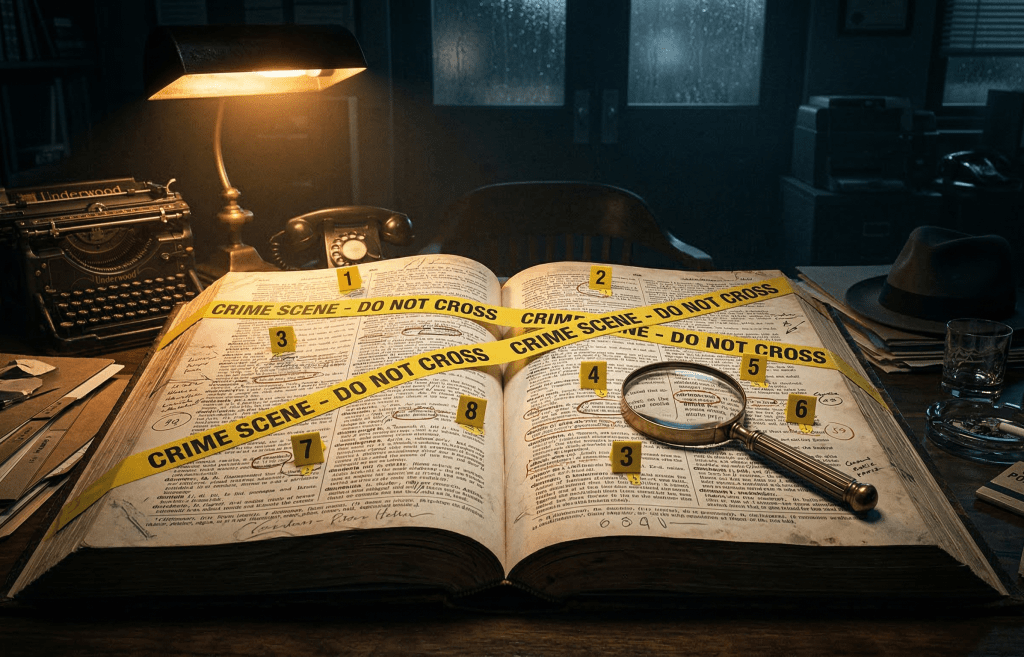
  • The Dictionary Is a Crime Scene

    The Dictionary Is a Crime Scene

    Every word you have ever said is a corpse with a previous life and nobody is conducting the investigation.

    I found this out on a Tuesday, which is itself named after Tyr, the Norse god who lost his hand to a wolf, which means every Tuesday you are walking around inside a day named after a man who got his hand bitten off by a cosmic predator and nobody mentions this. Nobody says “happy wolf-bite day.” Nobody acknowledges that the calendar is a graveyard of dead gods dressed up as productivity. Tuesday just sits there, looking innocent, wearing a suit, pretending it doesn’t have a wolf problem.

    I started pulling threads. This was a mistake. You should not pull threads in a language because the whole thing unravels and then you’re standing in a room full of yarn screaming about Latin roots at people who came here to have a normal conversation.

    The word “belong.” It showed up in a post I wrote that nobody liked. Zero likes. Sixty-six impressions. The post said that “belong” comes from Old English, meaning intense longing. That you belong somewhere because something in you reaches toward it. This is true. This is etymologically accurate. And apparently the internet does not care about etymological accuracy at 3 p.m. on a Sunday. But I care. I care because the word “belong” has been lying to us. We use it like a filing system. “This belongs here.” “I belong to this group.” “Where does this belong?” As if belonging is a matter of location. As if it’s a drawer you put something in. But the word itself, the bones underneath the skin, says belonging is an ache. A longing so intense it becomes identity. You don’t belong somewhere because you were assigned there. You belong somewhere because the wanting changed you into a person who couldn’t be anywhere else. Every time someone says “I don’t belong here” they are etymologically saying “I don’t long for this place,” and they’re right, and the word knew it, and nobody asked the word.

    This is what happens when you let usage define meaning instead of the other way around. Usage is a game of telephone played across centuries by people who didn’t read the manual. The word starts with a precise meaning, a surgical meaning, a meaning that cuts exactly where it needs to cut. Then someone uses it loosely. Then someone else hears the loose version and uses it looser. Then the loose version becomes the meaning and the original meaning gets buried and the word walks around like a person with amnesia, doing a job it doesn’t remember applying for.

    The biblical scholars know this. They’ve been fighting about translation for two thousand years because they understand that when you change a word, you change a world. “Virgin” or “young woman.” “Charity” or “love.” “Repent” or “turn around.” Each substitution is a fork in the road that sends millions of people in different directions, and the people walking down each fork are convinced they’re on the same road because the sentence looks the same from a distance. It doesn’t look the same up close. Up close, the difference between “love” and “charity” is the difference between a fire and a tax deduction.

    Now. Possess.

    I have been waiting to talk about this word the way a man waits to show you the weird thing he found in his basement.

    “Possess” comes from Latin. Potis, meaning able, powerful. Sedēre, meaning to sit. To possess something is to sit on it in a position of power. Not to own it on paper. Not to hold the title. To physically sit on top of a thing and dare someone to move you. That’s ownership. That’s the original contract. You possess what you can sit on. Your possessions are the things underneath you. The word is a throne, not a receipt.

    And then the word flips. Demonic possession. The same word. The same Latin bones. But now the thing is sitting on you. Now you are the chair. The power reversed and the word didn’t change and the fact that it didn’t change is the most honest thing about it, because the word was always saying that the relationship between possessor and possessed runs both ways. You sit on your possessions and your possessions sit on you and the word has been screaming this from inside the dictionary for centuries and we keep nodding and saying “yes, I possess a car” without noticing that the car also possesses us, that we build garages for it and pay insurance on it and wash it on Saturdays and rearrange our entire geography around its needs, and at some point the question of who is sitting on whom becomes genuinely difficult to answer.

    And then the word flips again. “A possessing quality.” She possesses the room. He has a possessing presence. Now nobody is sitting on anything. The power is ambient. It radiates from a person the way heat radiates from a thing you shouldn’t touch. And the word is still the same word. Still the Latin bones. Still someone seated in power over someone else. But the sitting has become metaphorical and the power has become atmospheric and the word has traveled from a throne to a demon to a feeling you get when someone walks into a room and you forget what you were saying, and all three meanings are the same meaning wearing different clothes and the word knows this and you didn’t and now you do.

    “Understand.” Under. Stand. To stand beneath something. Comprehension was originally an act of submission. You didn’t understand a thing by climbing above it and looking down. You understood it by getting underneath it and letting it be over you. Letting it be bigger than you. The word says that knowledge is not domination. Knowledge is the willingness to be smaller than the thing you’re trying to know. Every time someone says “I don’t understand” they are etymologically saying “I can’t get beneath this” and they are accidentally more honest than they intend to be.

    “Disaster.” Dis plus astro. A bad star. We used to blame the sky. When something terrible happened, it was because the stars were in the wrong position, which means the word “disaster” is a fossilized prayer, a two-thousand-year-old gesture of pointing upward and saying “that one. That star. That’s the one that did this to me.” We don’t believe in astrology anymore but we still use the word and the word still believes.

    “Mortgage.” Morte plus gage. A death pledge. Not a metaphor. Not dark humor. The original term. You sign a mortgage and you are making a pledge that dies when the debt is paid or when you are, whichever comes first. Every banker who has ever handed you a mortgage document has handed you a piece of paper with the word “death” in its name and smiled while doing it and the word sits there on the dotted line, grinning, knowing its own history, waiting for you to look it up.

    I keep finding these. I can’t stop finding these. The language is a crime scene and every word is a body and every body has a story and nobody is asking questions. We walk across the crime scene every day, speaking the dead like they’re furniture, stepping over etymologies that would change the sentence if we heard them, and the words let us. The words don’t complain. They just lie there, carrying their histories inside them like organs, still functioning, still pumping the old blood, even as we use them to order coffee and argue about parking and say “I love you” without knowing that “love” comes from a root meaning “desire” which comes from a root meaning “to be lost” which means every time you say I love you, the language underneath is saying I am lost because of you, and that’s either the most beautiful thing a word has ever done or the most devastating, and the difference depends on whether you’re the one saying it or the one hearing it, and the word doesn’t care, the word just sits there, on its throne, possessed by its own history, longing for someone to finally look it up.

  • A Field Guide to Haunted English

    A Field Guide to Haunted English

    I was three whiskeys into a Wednesday when the English language tried to kill me.

    It started with a text I didn’t send. I typed “if” and my phone autocorrected it to “is” and suddenly I had committed to something I was still negotiating. This is the problem. This has always been the problem. Is and if are separated by a single letter and an entire theology and my phone does not respect the difference. Nobody does. Is shows up with its whole chest. If keeps its jacket on. One of them built the church. The other one is circling the parking lot, has been circling the parking lot, will die circling the parking lot, because commitment is a vowel sound it cannot make. The sexual tension between these two words has been fueling all of literature and most of the rent I’ve paid on apartments I stayed in too long and I am not going to explain that further because if you felt it you felt it and if you didn’t I can’t help you and the fact that I just used both words in the same sentence and they’re doing completely different things should alarm someone.

    Nobody is alarmed.

    I went to a dinner party. I don’t know why I go to dinner parties. At this one, a man pronounced it plEthora and a woman pronounced it plethOra and for eleven seconds the room contained two separate realities and no one acknowledged it. I stood there holding a glass of something that had been described to me and realized this wasn’t a disagreement. This was a border dispute. Two nations sharing a word and refusing to share a flag. The man who says plEthora went to a college where people corrected each other. The woman who says plethOra learned it from Three Amigos. Both correct. Neither will back down. And if you listen, really listen, the pronunciation someone chooses tells you more about their childhood than any memoir. It tells you which books were in the house. Whether the television was an authority or a guest. The mouth remembers what the mind has edited and the mouth does not care about your rebrand.

    I left the party early. On the way home I tried to use faux pas in a sentence and nearly drove off the road.

    A sincere phonetically accurate pronunciation of faux pas sounds like someone falling down a flight of stairs in a language they don’t speak. Fawx pass. I said it out loud in the car. The car did not judge me. The car is the only safe space left for language. You can say anything in a car. You can pronounce faux pas like an American, which is what it is, in your mouth, right now, an American word wearing a beret it bought at the airport. English swallowed this phrase from French centuries ago and has been pretending to know what to do with it ever since. The whole arrangement is a man who stole a tuxedo and now has to attend the opera and he’s sweating through the shirt and smiling and the word, the word itself, means false step, which means pronouncing it correctly is a performance of not making a false step, which means the word about social failure can only be spoken by someone performing social success, which means it undermines itself every time someone gets it right and fulfills its own prophecy every time someone gets it wrong, and I am in my car yelling FAWX PASS at the windshield and the windshield is taking it.

    The language is haunted. I have been saying this to people. They do not invite me to dinner parties because of this but also I keep showing up. Every word drags behind it the corpse of every previous use and the corpse is not dead, it is pretending, and when you open your mouth the corpse sits up and says something you didn’t authorize. This is why you have said “I’m fine” in a tone of voice that means “I am disintegrating from the feet up.” The words were correct. The haunting was louder. The haunting is always louder.

    And now it’s later, or maybe it’s earlier, the timeline has become unreliable, and someone at a different party, or possibly the same party on a different night, is telling me about the Mandela effect, and I am nodding, and what I am actually thinking is that misremembering might be the most honest thing a mouth can do. That consensus pronunciation is a treaty nobody signed. That reality is a draft, not a publication, and enough people remembering it wrong is functionally the same as it having been different, and the Mandela effect is not a glitch, it’s a peer review that came back with edits, and the original author is furious, and the reviewers have already left the building, and the word is sitting on the page meaning two things at once and belonging to nobody.

    I got home. I typed something into my phone. My phone corrected it. I corrected my phone. My phone corrected my correction. We went back and forth like this for a while, two opposing theologies trapped in a device that fits in my pocket, and eventually I gave up and sent the message and it said what it said and not what I meant and the difference between those two things is a single letter and an entire religion and the parking lot is still being circled and the church is still being built and the tuxedo does not fit and never did and I said fawx pass one more time, quietly, to no one, and no one corrected me, and it was the truest thing I’d said all night.

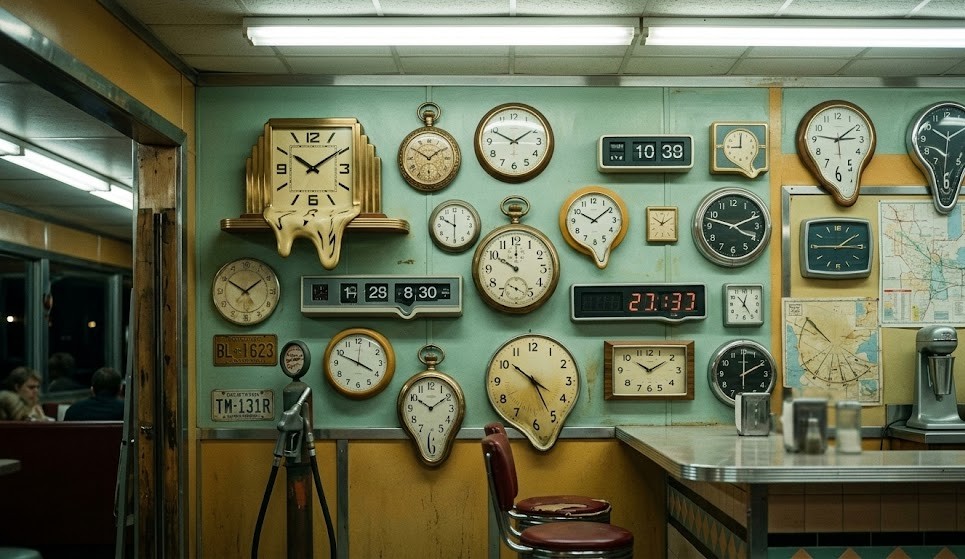
  • The Clock Is Drunk

    The Clock Is Drunk

    I lost February. I don’t mean it was short. I mean it left. One moment I was standing inside it and the next I was standing in March wearing the same pants and holding a coffee that had gone cold during a month I apparently attended but cannot account for. January, I remember. January lasted eleven years. Every week in January was a geological epoch. I aged visibly between Mondays. I developed opinions about oatmeal. I watched the same four walls perform a one-man show about endurance and I gave it three stars because it had no intermission. January was the kind of month that makes you check the calendar and then check it again because surely more time has passed than that, surely you have suffered enough for it to be at least April.

    And then February started, and I blinked, and the blink had a month inside it, and now I’m here.

    Does anybody really know what time it is?

    I asked this at a gas station. The man behind the counter looked at me like I had asked him to explain the moon. Which, fair. But I wasn’t being philosophical. I was being practical. My phone said 2:14. The clock on the wall said 3:07. The receipt said 1:58. Three machines in the same room, all powered by the same electrical grid, all connected to the same satellites, and not one of them could agree on when it was. This is the infrastructure. This is what we’ve built. A civilization of clocks that cannot keep time, arguing with each other on your behalf while you stand there holding a bag of peanuts and wondering if the afternoon has already happened or if it’s still pending.

    You don’t know what day it is either. I know you don’t. I can tell by the way you looked at your phone just now. You looked at it the way you look at a friend who owes you money. You looked at it hoping it would tell you something you could use and it told you a number and the number meant nothing. Wednesday. Is it Wednesday? It feels like Wednesday. It also feels like Friday and like a Sunday that got lost and ended up in the middle of the week wearing someone else’s name. The days are not organized. They are a drawer full of socks that used to match and now you just grab two and hope nobody looks down.

    I had a meeting yesterday. Or the day before. The meeting was about the future. Everyone in the meeting was very concerned about the future. They had slides. The slides had timelines. The timelines had quarters and the quarters had goals and the goals had deadlines and every single person in that room was pretending they knew what month it was. I sat there nodding. I have gotten very good at nodding. Nodding is the only skill that transfers across all temporal zones. You can nod in January. You can nod in whatever we’re calling this. You can nod at a gas station at a time that three different clocks cannot agree on and the nod still works. The nod is the universal constant. Not the speed of light. The nod.

    The slides said Q2. I wrote down Q2. I underlined it. I do not know when Q2 is. I know it comes after Q1 the way Wednesday comes after Tuesday, which is to say technically, on paper, in a system that somebody designed and the rest of us pretend to inhabit. But the system is drunk. The calendar is a suggestion that got laminated and hung on a wall and everyone agreed to take it seriously and nobody asked why. We all walk around carrying the same twelve-month hallucination and getting upset when it doesn’t match the way time actually feels, which is: January is a prison sentence. February is a rumor. March is the moment you realize you’ve been holding your breath and you don’t remember starting.

    The world may explode at any second and you’re still talking about tomorrow.

    That’s the part I can’t get over. The future tense. We use it constantly. We use it like it’s a place we can visit, like it’s a room at the end of the hall that we’ll get to eventually if we keep walking. “I’ll do it tomorrow.” “We’ll revisit this next quarter.” “Let’s circle back.” Circle back. As if time is a loop you can reenter. As if the meeting you missed is still happening somewhere and you just need to find the right hallway. The future tense is the biggest bluff in the language. It is a check written on an account that may or may not exist by the time the check clears, and we write them constantly, dozens a day, convinced that the bank will still be open tomorrow, which is itself a future-tense proposition, which means the whole operation is a pyramid scheme running on grammar and good faith.

    I got home. It was dark. It is always dark when I get home now, or it is still light, and the difference between those two things is a season I cannot locate on the calendar because the calendar and I are no longer speaking. I sat on the couch. I looked at my phone. My phone said it was a time. I chose to believe it. Not because I trusted it but because the alternative is standing in a gas station asking a stranger to explain the moon and I have already done that once this week. Or last week. Or during that part of February that apparently happened while I was blinking.

    The coffee is cold again. It keeps doing this. I keep making it hot and it keeps becoming cold and the process by which it transitions from one to the other is called time and I am beginning to suspect that time is not a force or a dimension or a river or any of the metaphors we use to make it behave. Time is a gas station clerk who doesn’t know the answer either but has to say something because you’re standing there, holding peanuts, waiting.

  • Fortune Cookie Factory

    Fortune Cookie Factory

    I have been running a fortune cookie factory out of a phone screen for approximately six months and nobody has called the health inspector.

    The operation is simple. I sit somewhere. A thought arrives. I compress the thought until it fits inside a sentence. I put the sentence on the internet. People open it. Some of them nod. Some of them save it for later, which means they put my sentence inside their phone, which means my thought is now living rent-free in a device that belongs to a stranger, which means I have broken into someone’s pocket using only grammar, which is either publishing or a very slow home invasion and I am not qualified to determine which.

    The product is fortune cookies. I know this because someone told me. They said my feed reads like a fortune cookie factory run by a philosopher who’s also funny, and I wrote that down, because when someone describes your entire operation in a single sentence you don’t argue with it. You laminate it. You tape it to the wall of the factory next to the other fortunes and you keep pulling the lever.

    The factory has no hours. The factory has no walls. The factory is wherever I am when a sentence shows up fully formed and demands to exist. I have manufactured fortunes in parking lots. I have manufactured fortunes during conference calls where someone was explaining Q2 and I was not listening because a seven-word thought about loneliness had just walked into my head wearing a hat and I had to deal with it immediately or it would leave and I would spend the rest of the day knowing I had something and let it go. The sentences do not wait. They are not polite. They show up, they stand in the doorway, and if you don’t write them down in the next eleven seconds they leave and they do not come back and you will never prove they were there.

    This is the job. I did not apply for this job. The job applied for me.

    The platform is called X, which used to be called Twitter, which used to be called something people enjoyed saying out loud. Now it is called a letter. The letter X. As in: solve for. As in: the variable. As in: nobody knows what this place is anymore and the name finally reflects that. I operate inside it the way someone operates inside a hotel lobby. I am not a guest. I am not staff. I am sitting in the cafe in the lobby, watching people check in and check out, and occasionally I say something from my table and the acoustics carry it further than either of us expected.

    There are people in this lobby paying for attention. I know this because the economics are visible if you sit still long enough. Attention is the currency. Not money. Not clout. Attention. Raw, uncut, mainlined attention, measured in impressions, which is a word that means “the number of times your sentence appeared on a screen” and also a word that means “the mark left by pressing one thing into another.” Both definitions are operating simultaneously and nobody acknowledges this. Every time your post gets an impression, you have pressed yourself into a stranger. Every time you scroll past someone’s post without stopping, you have received an impression you did not process. The lobby is full of people pressing themselves into each other and not stopping and the cafe is full of coffee I did not order and fortune cookies I cannot stop making.

    Paying attention versus paying for attention. That’s the whole economy. One of them costs you time. The other costs you money. One of them is a gift you give with your eyeballs. The other is a receipt. And the platform cannot tell the difference. The platform counts both the same way. The algorithm sees a pair of eyes that lingered for four seconds and a pair of eyes that were purchased for four cents and it calls them the same thing and files them in the same column and the column is called engagement, which is also what you call it when two people decide to get married, which means the algorithm thinks your eyeballs just proposed to my sentence and I don’t know what to do with that information except put it in a fortune cookie and pull the lever again.

    I scroll your media sometimes. Not to spy. To study. The media tab on someone’s profile is the truest thing about them. Not the bio. Not the pinned tweet. The media tab. It’s every image they chose to attach to a thought, arranged in a grid, and the grid is a portrait the person did not know they were sitting for. You can see what someone finds beautiful. You can see what they find funny. You can see the exact ratio of sincerity to irony in their visual diet and the ratio tells you everything the bio was trying to hide. Scrolling someone’s media is reading their diary through the pictures they taped to the cover. Nobody talks about this. Everybody does it.

    The fortune cookie factory is still running. It runs at night. It runs during meals. It runs in the shower, which is inconvenient, because the sentences arrive wet and urgent and by the time I’ve dried off enough to type, half of them have dissolved. The ones that survive are the ones that were strong enough to wait. Those are the ones that end up in your feed at 11 p.m. when you should be asleep but you’re not, you’re scrolling, you’re in the lobby, and a sentence from a stranger’s table reaches you across the room and you stop for four seconds and the algorithm files it and I have pressed myself into you again and neither of us asked for this and both of us are still here.

    Pull the lever. Crack the cookie. Read the fortune. Throw the cookie away. Everyone does. Nobody eats the cookie. The cookie was never the point.

  • You’re Someone’s Anecdote

    You’re Someone’s Anecdote

    Somebody at a bar once pointed at me and said “hey, you’re weird, right?” and I said yes before I realized it wasn’t a compliment. Or maybe it was. The thing about being called weird is that the word doesn’t come with stage directions. It just arrives. You can play it as accusation. You can play it as invitation. You can play it as the moment in a movie where the protagonist realizes he’s been the side character in someone else’s story the whole time, which is closer to what actually happened, because the person who said it wasn’t asking. They were confirming. They had already decided. I was weird the way a lamp is a lamp. It was not up for discussion.

    This is how identity works. Not from the inside. From the outside. You think you’re building yourself, one decision at a time, stacking up choices and preferences and beliefs into a structure you can point at and say “that’s me.” But the structure everyone else sees is different. The structure everyone else sees is the one they built out of the four sentences you said at that party and the way you laughed at the wrong joke and the time you showed up wearing something they didn’t expect. You are not the architect of your own reputation. You are the building materials. Other people are doing the construction and they did not consult the blueprints because there are no blueprints because you never drew any because you were too busy being alive to sit down and draft a plan for how alive you were going to be.

    I’m as interesting as you want me to be. I’ve been thinking about this for weeks. It showed up as a sentence and then it showed up as a problem. Because it’s true. Not in a self-deprecating way. In a structural way. Interest is not a property of the object. Interest is a property of the attention. A rock is boring until a geologist picks it up. A sentence is nothing until someone stops scrolling. I am whatever happens in the space between what I said and what you decided I meant, and that space is not mine. I don’t control it. I furnish it. I leave things in it. But you’re the one who walks in and decides whether it’s a living room or a crime scene.

    You’re someone’s “this one time, I met a somebody who…” Right now. Already. You have been metabolized into anecdote by people you do not remember meeting. You exist in stories being told at dinner tables you will never sit at, and the version of you in those stories is wearing clothes you may not own and saying things you may not have said and the person telling the story is not lying. They are remembering. And memory is not a recording. Memory is a cover band. It plays the song but it changes the key and adds a guitar solo that wasn’t in the original and the audience doesn’t know the difference because they weren’t at the first concert.

    I met a woman once who told me about a man she’d met at an airport. She described him for six minutes. His coat. His laugh. The thing he said about turbulence. I asked if she got his name. She hadn’t. He existed in her life as a texture, a moment with a coat and a laugh, and he will never know this. He is walking around right now, being a person, doing his taxes, and somewhere across the city a woman is telling a stranger about his coat at an airport and the stranger is me and I am now carrying him too. He has passed through three people without any of us knowing his name and he is more alive in that passing than most people are on purpose.

    You have to be one of those people if you want to be one of those people. But the trick, the thing nobody tells you, is that you already are. You already are someone’s airport story. You already are the weird one at the bar, the sentence someone saved, the laugh someone carried home without checking whose it was. The identity you’re trying to build from the inside is already built from the outside, and it doesn’t look like your plans, and it was never going to, because the people doing the building are using their own tools and their own memories and their own need for you to be a certain shape so you fit in the space they’ve made for you, and you will never see that space, and it is more real than anything you’ve ever said about yourself on purpose.

    I know this because someone once described me to someone else while I was standing right there, and the person they described was someone I had never met. And I liked him. He sounded interesting. More interesting than the one I’d been building on purpose.