The Hofflebrock

Author: The Hofflebrock

  • The Hustle vs. The Protocol: Why Cardone’s 52 Rules Break Your Brain

    A Translation Matrix for the Neurodivergent Operator
    The Problem With Hustle Culture

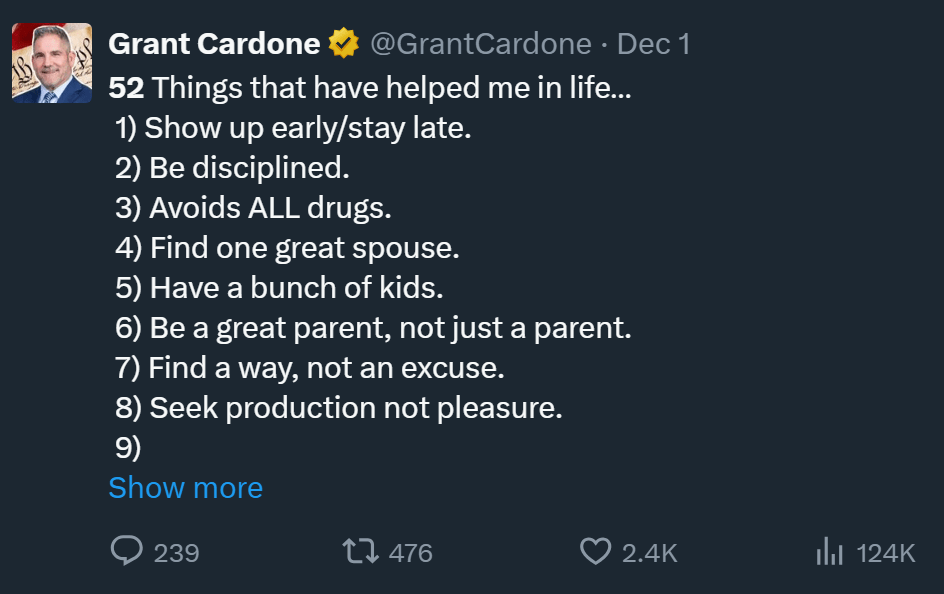
    Grant Cardone’s 52 rules for success are seductive. Work harder than everyone else. Show up early. Stay late. Find a way, not an excuse.

    For the neurotypical grinder, these are commandments. For those with ADHD, Autism, or generic Executive Dysfunction, these rules are not just ineffective. They are corrosive.

    The core assumption of hustle culture is that willpower is the only variable. It assumes energy is infinite. It assumes that if you are not succeeding, you are simply not trying hard enough.

    This is neurotypical mythology.

    For those operating on the Bathys Protocol (a framework designed for finite executive function), we require a different approach. We need systems that manage the load rather than mantras that shame the limitations.

    This is not a rejection of Cardone’s ambition. It is a recompilation for a different operating system.

    Executive Function is Voltage

    Traditional productivity advice treats the brain as a binary switch. You are either disciplined or lazy. You either hustle or you make excuses.

    Neuroscience offers a different schematic. Executive function operates as voltage. You possess a finite charge each day. Complex tasks drain it. Decision fatigue compounds it. When you hit zero, motivational speeches do not restore the charge. Recovery does.

    The Bathys Protocol recognizes this reality. It builds on three pillars:

    1. Density over Duration: Compress work into high-efficiency blocks.
    2. Diagnostics over Guilt: Identify the constraint rather than the moral failing.
    3. Leverage over Labor: Scale systems. Do not scale hours.

    The Translation Matrix

    We do not discard the 52 rules. We translate them. Here are the critical reframes.

    Rule #1: “Show up early / Stay late”

    • The Trap: Sensory burnout. For the neurodivergent professional, physical presence in a retail or office environment drains voltage without increasing output. You confuse attendance with productivity.
    • The Protocol: Density over Duration. Compress the workload. Use asynchronous prep to load tomorrow’s decisions today. Automate the close. High-impact work blocks beat loitering time.

    Rule #7: “Find a way, not an excuse”

    • The Trap: The shame spiral. When executive dysfunction hits, labeling it an “excuse” causes paralysis. You cannot force your way through a dopamine deficit.
    • The Protocol: Diagnostics Over Guilt. Is it a lack of skill? Lack of fuel? A bad process? Fix the mechanism. When you cannot focus, the problem is not your character. It is your system.

    Rule #10: “Study the greats”

    • The Trap: Mimicry. Copying surface-level behaviors of extroverted sales types leads to masking. You will burn out trying to perform a personality that does not exist.
    • The Protocol: Analyze the Source Code. Deconstruct the principles used by successful entities. Look at Jung’s shadow work or Musk’s first-principles thinking. Recompile them for your operating system.

    Rule #12: “Scale everything”

    • The Trap: Operator overload. You try to clone your personal effort linearly. You cannot make 10x more sales calls yourself without destroying your mental health.
    • The Protocol: Scale the System. Build the engine. Use SOPs, AI agents, and marketing funnels. Detach revenue from your time. The machine grows while your workload stabilizes.

    Rule #21: “Don’t make sense of nonsense”

    • The Trap: Analysis paralysis. The INTP urge to dissect irrational behavior wastes precious mental cycles.
    • The Protocol: Navigate, Don’t Debate. Acknowledge irrationality as a terrain feature. It is a rock in the road. Move around it. Save processing power for solvable problems.

    Rule #24: “Work harder than everyone else”

    • The Trap: The grinder mentality. Leading by sweat keeps you trapped in tactical weeds instead of strategic architecture.
    • The Protocol: Leverage Over Labor. Work smarter. Focus on strategic planning and dashboard creation. Build tools that multiply impact without multiplying hours.

    Rule #27: “Become a master communicator”

    • The Trap: Sales pitching. This views communication solely as extraction (closing deals).
    • The Protocol: Transmission of Clarity. Master narrative and instruction. Write clear SOPs. Focus on high-fidelity information transfer that reduces error rates.

    Rule #49: “Know you’re entitled to nothing”

    • The Trap: Nihilism. Without proper framing, this leads to a bleak outlook.
    • The Protocol: Agency is Absolute. The universe is indifferent. You are the sole architect of the outcome. This is radical responsibility. It is the elimination of victimhood.

    The Synthesis: Fuel Meets Engine

    Hustlers like Grant are the fuel. The Bathys Protocol is the engine.

    We do not discard the ambition. We discard the inefficiency. We use the pressure Cardone suggests to drive the systems we build, not to crush the operator.

    Hustle without systems leads to burnout. Systems without ambition lead to stagnation.

    Action Items

    1. Audit your voltage. What tasks deplete you disproportionately? Automate or eliminate them.
    2. Build one system. Pick the lowest-hanging fruit. An email template. A checklist. A decision tree.
    3. Track your stats. Not vanity metrics. Track leading indicators. Hours of deep work. System creation. Revenue per hour.
    4. Protect the OS. Sleep and boundaries are not luxuries. They are operational requirements.

    The hustle gets you started. The protocol keeps you alive.


    How Much Battery Do You Have Left?

    You can keep trying to Cardone your way through the fatigue. You can keep stripping your gears until the machine breaks.

    Or you can fix the design.

    The Bathys Protocol teaches you how to map your voltage, protect your energy, and produce at scale without the crash. Do not wait until you hit 0%. The cost of recovery is too high.

    Secure Your Copy

  • The Art Deco Kraken

    When the Chrysler Building pierced the Manhattan skyline in 1930, it proved something revolutionary: the machine age didn’t have to be cold or brutal. Art Deco said that complexity could be elegant, that power could be beautiful, and that geometric precision could sing.

    This is why Art Deco isn’t just an aesthetic choice for Bathys; it’s the operating logic made visible. It is the only choice that makes the framework itself legible.

    Standard productivity advice tells you to simplify. Focus on what matters most. Just pick one thing. This is the equivalent of telling an architect to build a rectangular box because curves are complicated.

    But you are not simple. Your brain generates capability across multiple domains simultaneously. Career ambitions interweave with creative projects. Relationship maintenance overlaps with physical health. The logistics of continued existence bind it all together. Five tentacles, each one powerful, each one reaching toward different horizons. The neurotypical advice to “do less” is asking you to amputate capability rather than coordinate it.

    Art Deco emerged to solve exactly this problem. The Industrial Revolution created complexity that previous aesthetic frameworks couldn’t handle. You couldn’t address a streamlined locomotive or a radio tower with Victorian ornament. Society needed something new. It needed a visual language that acknowledged overwhelming capability while organizing it through mathematical precision and hierarchical structure.

    The Art Deco kraken embodies this solution perfectly. Each tentacle is rendered with geometric exactitude. Parallel lines suggest muscle striations. Metallic gradients create depth and direction. Zigzag patterns borrowed from lightning bolts add controlled energy. These aren’t chaotic decorations scattered randomly across the form. Every element reinforces the tentacle’s direction, its power, and its relationship to the central head. The composition directs your eye through angles and emphasis, making it clear which tentacle is active, which are supporting, and which are in reserve.

    This is executive function made visible.

    The head doesn’t control through suppression. It doesn’t succeed by making the tentacles smaller or fewer. It coordinates through clear hierarchical structure. This tentacle moves now. That tentacle moves next. Those three remain in maintenance mode. The geometry makes these relationships legible. You can see which tentacle is primary in any given moment because the visual architecture tells you.

    Art Deco also solved a problem that Bathys confronts directly: how do you make something inherently overwhelming feel manageable to encounter? The style did this through repetition and pattern. Look at any Art Deco building facade. There might be thousands of individual elements, but they organize into repeated patterns the eye can parse. Vertical lines group into clusters. Setbacks create clear tiers. The complexity doesn’t disappear; it becomes legible.

    Bathys uses this same architecture. You might have dozens of active projects across five life domains, but they are organized into parseable patterns. Individual actions cluster into projects. Projects cluster into tentacles. Tentacles follow your current mode state. You are not pretending to be simpler than you are. You are making your actual complexity visible to yourself so you can coordinate it.

    There is something else crucial here. Art Deco was fundamentally optimistic about capability. It emerged during a period when humans could suddenly build skyscrapers a quarter-mile high, cross oceans in days, and transmit voices through the air. The style looked at this overwhelming expansion and said yes, AND we can organize it into something magnificent.

    This is the emotional core that makes Art Deco essential for Bathys. The framework is not about coping with deficiency or managing your limitations. It is not about accepting that you are too broken to function normally. It is about recognizing that you have exceptional capability that requires exceptional coordination systems. You are not a broken bicycle. You are a multi-engine aircraft that needs a more sophisticated cockpit.

    The materials matter too. Chrome, brass, copper, and gold don’t absorb impact and dampen. They conduct energy and reflect. This is what good systems do for high-capability people with variable executive function. They don’t reduce your energy or contain your chaos. They conduct your capability and reflect it back to you in organized form.

    When your executive function is strong, the Art Deco aesthetic represents what you can achieve: power coordinated through elegant systems into something that makes people stop and stare. When your executive function weakens, the style represents the external structure that holds when your internal coordination fails. The building stands because the architecture is sound, not because someone is consciously holding it up every moment.

    This is why the Art Deco kraken isn’t decoration or branding. It is the framework’s central metaphor made visual. Every element you see in the image is teaching you what Bathys does and why it works. The geometric precision. The metallic coordination. The radiating structure. The celebration of complexity made elegant through deliberate organization.

    You are not too much. You are exactly as much as you are, and that amount of capability deserves systems worthy of it. Art Deco refused to be embarrassed by power. It refused to simplify down to weakness. It took overwhelming capability and made it magnificent through structure.

    Complexity coordinated through geometric structure becomes elegance. Power directed through hierarchical systems becomes precision. Capability acknowledged and organized becomes achievement.

    This is Bathys. This has always been Bathys.