The Hofflebrock

Category: Essays

  • You’re Someone’s Anecdote

    You’re Someone’s Anecdote

    Somebody at a bar once pointed at me and said “hey, you’re weird, right?” and I said yes before I realized it wasn’t a compliment. Or maybe it was. The thing about being called weird is that the word doesn’t come with stage directions. It just arrives. You can play it as accusation. You can play it as invitation. You can play it as the moment in a movie where the protagonist realizes he’s been the side character in someone else’s story the whole time, which is closer to what actually happened, because the person who said it wasn’t asking. They were confirming. They had already decided. I was weird the way a lamp is a lamp. It was not up for discussion.

    This is how identity works. Not from the inside. From the outside. You think you’re building yourself, one decision at a time, stacking up choices and preferences and beliefs into a structure you can point at and say “that’s me.” But the structure everyone else sees is different. The structure everyone else sees is the one they built out of the four sentences you said at that party and the way you laughed at the wrong joke and the time you showed up wearing something they didn’t expect. You are not the architect of your own reputation. You are the building materials. Other people are doing the construction and they did not consult the blueprints because there are no blueprints because you never drew any because you were too busy being alive to sit down and draft a plan for how alive you were going to be.

    I’m as interesting as you want me to be. I’ve been thinking about this for weeks. It showed up as a sentence and then it showed up as a problem. Because it’s true. Not in a self-deprecating way. In a structural way. Interest is not a property of the object. Interest is a property of the attention. A rock is boring until a geologist picks it up. A sentence is nothing until someone stops scrolling. I am whatever happens in the space between what I said and what you decided I meant, and that space is not mine. I don’t control it. I furnish it. I leave things in it. But you’re the one who walks in and decides whether it’s a living room or a crime scene.

    You’re someone’s “this one time, I met a somebody who…” Right now. Already. You have been metabolized into anecdote by people you do not remember meeting. You exist in stories being told at dinner tables you will never sit at, and the version of you in those stories is wearing clothes you may not own and saying things you may not have said and the person telling the story is not lying. They are remembering. And memory is not a recording. Memory is a cover band. It plays the song but it changes the key and adds a guitar solo that wasn’t in the original and the audience doesn’t know the difference because they weren’t at the first concert.

    I met a woman once who told me about a man she’d met at an airport. She described him for six minutes. His coat. His laugh. The thing he said about turbulence. I asked if she got his name. She hadn’t. He existed in her life as a texture, a moment with a coat and a laugh, and he will never know this. He is walking around right now, being a person, doing his taxes, and somewhere across the city a woman is telling a stranger about his coat at an airport and the stranger is me and I am now carrying him too. He has passed through three people without any of us knowing his name and he is more alive in that passing than most people are on purpose.

    You have to be one of those people if you want to be one of those people. But the trick, the thing nobody tells you, is that you already are. You already are someone’s airport story. You already are the weird one at the bar, the sentence someone saved, the laugh someone carried home without checking whose it was. The identity you’re trying to build from the inside is already built from the outside, and it doesn’t look like your plans, and it was never going to, because the people doing the building are using their own tools and their own memories and their own need for you to be a certain shape so you fit in the space they’ve made for you, and you will never see that space, and it is more real than anything you’ve ever said about yourself on purpose.

    I know this because someone once described me to someone else while I was standing right there, and the person they described was someone I had never met. And I liked him. He sounded interesting. More interesting than the one I’d been building on purpose.

  • The Fire Started Itself

    The Fire Started Itself

    The world is on fire and nobody lit it. That’s the part that bothers me. Not the fire. The fire I can work with. Fire is at least a thing. Fire has behavior. You can study fire. You can stand at a reasonable distance and take notes on fire. What you cannot do is find the person who started it, because there is no person, because the fire started itself, and a fire that started itself does not have demands and cannot be negotiated with and does not care about your timeline for when it should stop.

    I keep watching people look for the arsonist. This is the main activity now. Identifying who lit it. Was it the billionaires. Was it the algorithms. Was it the other political party. Was it the generation before us or the generation after us or the specific generation currently in charge of the specific institution currently producing the most smoke. Everyone is standing in a burning building arguing about the origin point while the ceiling develops opinions about gravity, and I am standing in the corner thinking: what if nobody lit it. What if the building was always going to burn. What if the materials were wrong from the start and the structure was stressed in places nobody checked and the fire is not an event but a consequence and the consequence has been arriving in slow motion for decades and we just didn’t call it fire until we could feel the heat.

    This does not help. Knowing the fire started itself does not help put the fire out. But it does change what you do next. Because if someone lit it, you find them and you stop them. That’s a quest. That has a villain and a resolution and a shape you can hold in your hands. But if the fire started itself, there’s no villain. There’s no quest. There’s just a burning room and you, in it, deciding what to do with the fact that the room is smaller than it was yesterday and will be smaller again tomorrow.

    Describe an unseen shape.

    I keep coming back to this. Not as poetry. As instructions. The shape I can see is the fire. The shape I can’t see is what the fire is revealing. Because fire does that. It removes. It takes away walls and ceilings and assumptions and the furniture you forgot you’d arranged your life around, and when it’s done, if you’re still standing, the room is a different room. Not because something was added. Because something was taken away. And the thing that was taken away was blocking your view of something you didn’t know was there.

    Building something versus removing what’s hiding it. That’s the question and I don’t think most people realize there are two options. The default response to a fire is to rebuild. Get the plans. Call the contractor. Put the walls back where they were. Hang the same pictures. Buy the same furniture. Rebuild the room you had, because the room you had is the room you knew, and knowing is safer than discovering. But what if the room you had was wrong. What if the walls were in the wrong place. What if the fire, which nobody started and nobody asked for, is doing the work you were never going to do yourself because you were too comfortable and too afraid and the furniture was fine, the furniture was good enough, the furniture was arranged in a way that let you move through the room without ever looking at the parts of it you’d been avoiding.

    By removing the old life, the subject creates a vacuum that pulls the new life into existence without manual labor. I wrote that during a week when three things I had built fell apart simultaneously. A relationship to a job. A version of my schedule. A belief about what I was supposed to be doing next. None of them were destroyed by enemies. None of them were taken from me. They just stopped being true. The way a fire stops needing permission. The way a structure stressed in the wrong places eventually does what stressed structures do, which is reveal where the stress was, which is information you could not have gotten any other way, which means the collapse was also a diagnosis, which means the worst week was also the most honest week, which is a hell of a thing to realize while you’re standing in the ashes of your quarterly plan.

    I am not going to tell you the fire is good. The fire is not good. The fire is fire. It is not for you or against you. It does not have a lesson plan. It is not a metaphor that resolves into personal growth if you squint at it from the right angle on a Sunday morning with enough coffee. The fire is the removal of things that were in the way and some of those things you loved and some of those things were keeping you warm and the fact that they were also blocking the door is not a comfort, it is just a fact, and facts do not care about your comfort, which is something the fire and the facts have in common.

    Every time I tried to build over the ashes without looking at what the fire had shown me, the fire came back. And every time I stopped rebuilding and started looking, really looking, at the new shape of the room, something fit that didn’t fit before. A door where a wall used to be. A window where there used to be a bookshelf full of books I’d already read. The shape was always there.

    The world is on fire. Nobody lit it. There is no arsonist to catch, no quest to complete, no villain to defeat. There is just a room that is changing shape whether you want it to or not, and the only choice is whether to keep rebuilding the old walls or stand in the new space long enough to see what it looks like without them.

    I’m standing. It looks different in here. I don’t know what it looks like yet. The smoke hasn’t cleared. But I can feel the edges of something, the way you feel a draft before you find the window, and the draft is coming from a direction the old room didn’t have.

  • The Shape, Not the Material

    The Shape, Not the Material

    A few weeks ago I wrote about cameras. About the way we turn them on our own situations, the way the act of watching replaces the act of moving, the way the angle becomes the anesthetic and the frame becomes the freeze. I thought that was the problem. I was satisfied with that. I had named the disease, prescribed maintenance over narrative, told you the dishes are just dishes and the leak is just a leak, and I walked away from the keyboard feeling like I had solved something.

    I had not solved something.

    I had solved the outer layer of something and mistaken it for the whole thing, which is exactly the kind of move I was warning against, which means the essay about self-deception was itself a form of self-deception, and if you think that’s funny, you’re right, it is funny, and I am only now catching up to the joke.

    You can turn off the camera. You can refuse the noir filter, reject the political drama, stop treating your paralysis as content. You can do all of that and still be stuck. Because even when you stop framing the external situation, you’re still standing in the wrong part of the room. You just can’t tell, because the lights are finally on and you assumed that was enough.

    It wasn’t enough.

    I know this because three things I wrote recently circled the same drain without any of them going down it. The first was about my persona online. I had been selling shadow for months. Dark observations, bitter edges, the kind of content that pulls engagement because it gives people something to push against. Then I announced I was going to lighten up. Not gradually. Publicly. Like a man standing on a stage telling the audience he’s about to change the play they paid to see.

    The metrics collapsed within forty-eight hours.

    My first read was that audiences are fickle. That they wanted the darkness and rejected the light. That the mask was a trap I couldn’t escape without losing everything I’d built. This interpretation let me feel like a victim of my own success, which is a very comfortable feeling, like a warm bath with a view, and I sat in it for a while before I noticed the water was getting cold.

    The mask wasn’t costume. The mask was architecture. I had built a structure my audience was living inside, and then I demolished it without warning. They didn’t leave because they rejected my happiness. They left because the building fell down. I thought I was the face behind the mask. I was the structure the face lived inside. Different thing entirely. The face is replaceable. The structure is what everyone was standing on.

    The second piece was about education. About deaths of despair and the boys falling through cracks that keep getting described as temporary but have been there long enough to develop weather patterns. The argument traced a line from mortality statistics to a single variable: whether someone got the cognitive architecture that makes agency possible. Not the degree. The operating system underneath the degree. The ability to hold a goal across time and navigate toward it despite the fact that everything is on fire and the fire started itself and nobody is coming.

    We talk about education as credential. Sorting mechanism. Class marker. But the actual function, when it works, is the installation of an operating system. Executive function. Impulse control. The capacity to see a future you might affect. Kids aren’t failing because they lack credentials. They’re failing because the OS never got installed, and we keep troubleshooting the applications while the hard drive spins in the dark.

    The third thing was about death. Not the final one. The constant one. The dissolution of moments passing, the versions of yourself that ended without ceremony, the background hum of loss that sits underneath everything like hold music you forgot you were listening to. The frame we apply to this is grief. Or failure. Or the sense that something essential is being taken from us, that we are diminishing, that each cut removes something we needed.

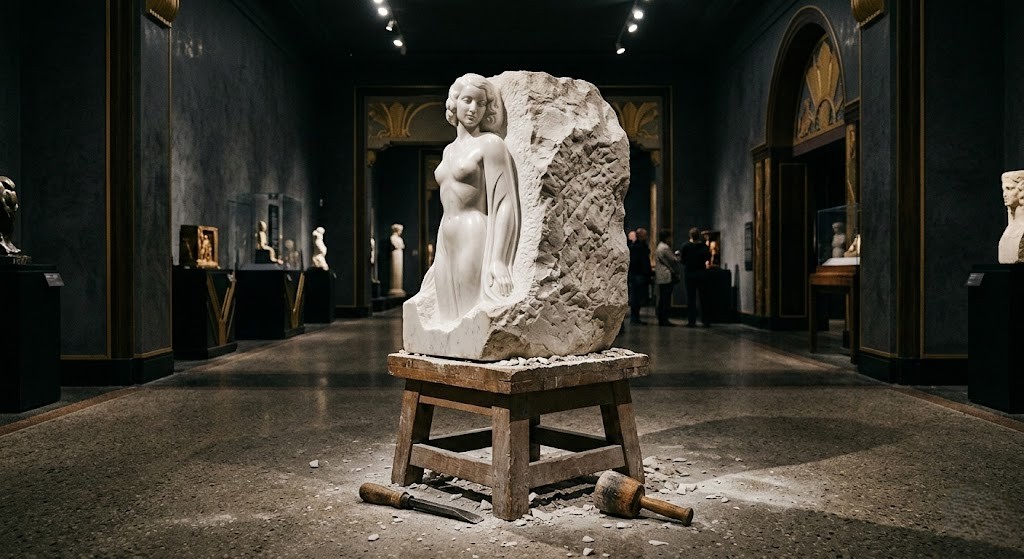
    But the sculptor doesn’t mourn the marble on the floor. The carving reveals the shape. The shape was always there, waiting to be uncovered by the removal of everything that wasn’t it.

    I thought I was the thing being diminished. I might be the thing being revealed. That sentence landed differently than I expected when I wrote it.

    Three pieces. Three versions of the same mistake. I located myself in the face instead of the architecture. In the credential instead of the capacity. In the marble instead of the form. Every time, I pointed at the visible thing and said “that’s me” and every time the visible thing was the part that was supposed to fall away.

    I don’t have a clean answer for this. I had one for the camera problem. Stop filming. Do the dishes. But this is different. This is the part where you’ve already stopped filming and you’re standing in the room with the lights on and your hands empty and you realize you’ve been mourning the wrong thing. You’ve been grieving the marble. The marble was never you. The marble was what was in the way.

    Maybe the answer is temporal. The material is what you were. The shape is what you’re becoming. Maybe the answer is attentional. You can’t see the shape directly, but you can feel its edges by noticing what’s being removed, the way you can feel wind by what it moves through. Maybe the answer is faith. Not the religious kind. The structural kind. The belief that removal is revelation rather than destruction.

    I don’t know which one is right. I wrote an entire essay a few weeks ago with the confidence of a man who had figured something out, and it turns out I had figured out the lobby and mistaken it for the building. So I am doing the honest thing here, which is admitting that the map I drew last time was accurate but incomplete, and the territory keeps going, and I am still walking, and the marble is still falling, and I am trying very hard to believe it’s supposed to.

  • The Angle Is the Anesthetic

    The Angle Is the Anesthetic

    Nothing so glamorous as a diagnosis.

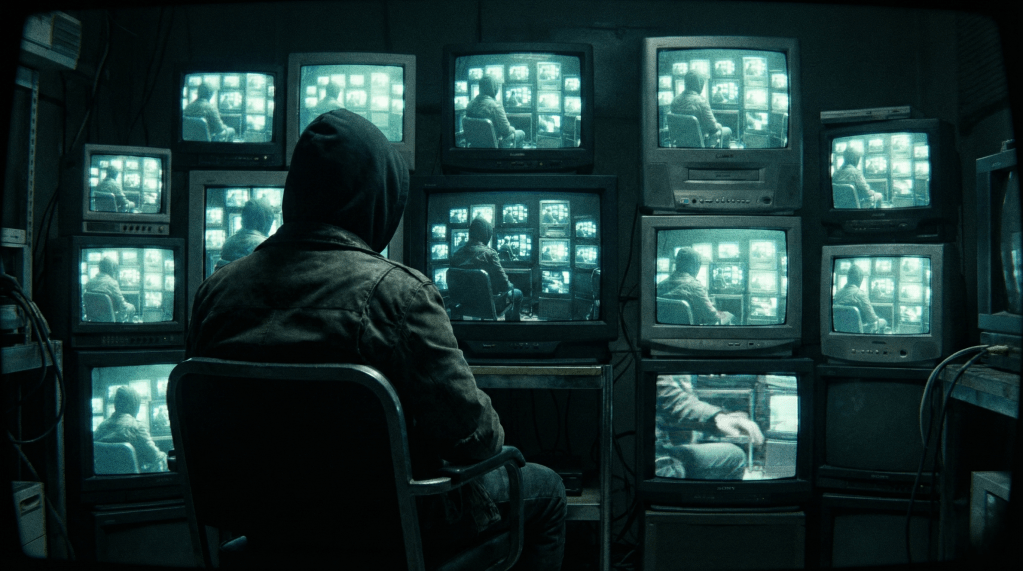
    We have learned to frame our paralysis. The political situation has a topology now. The gender trap has a grammar. The personal decay has a filter. Each frame arrives with its own lighting setup, its own implied camera angle, its own suggestion that someone, somewhere, is watching this unfold with appropriate gravity. This is not observation. This is production.

    The aesthetic frame is a compression algorithm, taking high-entropy data and smoothing it into signal. The itemized list of your failures, the specific texture of each neglected thing, the way the light in your kitchen does nothing for anyone. Uncompressed, this is noise, and the mind cannot hold noise, so the frame arrives and suddenly the noise has a shape. Melancholy. Oppression. Systemic capture. You can hold a shape. You cannot hold the raw feed. This is survival. The filter makes the mess bearable by making it mean something. But understand what the filter purchases: the moment your situation has a look, you are no longer inside it. You are watching it. The frame creates a camera, and the camera requires an operator, and the operator is the part of you that used to be capable of action but is now busy observing, tracking the aesthetic coherence of your own paralysis, taking notes on how well you are suffering.

    Consider the grammar of gender. We describe men with verbs. Women with nouns. This is not merely observation but assignment: she is watched into essence, the gaze fixing rather than recording, tightening until motion becomes impossible because any motion threatens the observer’s investment in the category. She is trapped in visibility. Observed into paralysis. He is watched for motion, the gaze tracking his trajectory, asking what he has done lately, and the moment that trajectory flatlines, scrutiny becomes deletion. The system has no category for the stationary man, so it stops seeing him entirely. He does not receive a noun for stillness. He receives nothing. Different cages. Identical locks. But notice the frame. The grammar does not just constrain; it provides a dramatic structure that makes the constraint feel like fate rather than arbitrary assignment, and the symmetry is almost beautiful. She envies his motion without seeing the hollow it covers. He envies her stillness without seeing the pressure it contains. Neither sees the other’s trap clearly because the grammar teaches each that the other has what they lack, and the lock holds because both believe the other has the key. This is aesthetic capture at the identity level. The trap has good lighting. The lighting is part of what makes it hold.

    The political frame operates the same way. The bilateral model of elite versus masses is a dramatic shape that feels like clarity: industrialists on one side, workers on the other, the interdependence creating leverage, the leverage creating negotiation, the negotiation creating rights. This is how we understand political power. Two sides. One wins. But bilateral structure was a product of industrial conditions, not a law of political physics, and the French Revolution did not happen because the peasantry had leverage. It happened because the aristocracy could not coordinate. Crown versus parlements versus provincial nobility versus emerging bourgeoisie versus Church, each faction bidding for popular support against rival factions, the masses becoming a resource in elite civil war rather than an independent force with structural power. The pattern repeats across every major rights expansion if you look for it. The Magna Carta was barons using the threat of civil war to extract concessions from the Crown. American labor rights emerged from Progressive Era elite factions who saw organized labor as a counterweight to rival industrial interests. The masses as independent actor with leverage is the bilateral fantasy. The masses as resource in factional competition is the historical pattern. But faction-shopping does not photograph well. It lacks the dramatic clarity of righteous opposition, so we keep the bilateral frame because it makes us protagonists in a film about our own powerlessness, and protagonists have arcs, and arcs have endings, and endings imply that someone, somewhere, is writing the script. You trade tractability for tragedy. The upgrade comes with a better poster.

    The pattern recurs because the function is the same. Situation becomes unbearable. Aesthetic frame makes it watchable. Watchability converts actor to audience, and the audience position removes responsibility to act, so the situation persists, now with better lighting. The noir filter compresses the specific smell of clothes worn one time too many into structured melancholy. The gender grammar compresses arbitrary assignment into tragic symmetry. The political frame compresses factional complexity into righteous underdog narrative. Each compression makes the situation survivable. Each compression also makes it permanent. You stop fixing the leak because the water dripping into the bucket has a certain rhythm to it, almost like a brush on a snare drum, almost like a soundtrack, and you stop questioning the grammar because the symmetry is too elegant to be accidental, and you stop looking for faction entry points because the bilateral drama is too satisfying to abandon. The angle is the anesthetic. The frame is the freeze.

    The obvious counter is to turn on the fluorescents, to see it without the angle, but this is just changing genres. Cinéma vérité is still cinema. The man in front of the open refrigerator at 2 a.m. is as much a trope as the man with the cigarette in the rain. You have traded the stylized for the raw, but you are still watching, still framing, the dissociation persisting because the camera is still rolling. And the silence under the fluorescents is not neutral. It is accusing. The noir filter was a painkiller that you just stopped taking without a plan for what comes next, and now the guilt surfaces, the itemized list returns, the specific weight of each undone thing lands all at once. You have removed the aesthetic and gained only the full resolution of the mess, which is worse than the compressed version and no more actionable. Switching filters is not the escape. You cannot aestheticize your way out of aestheticization.

    The third state is not noir. Not brutalism. Function. Maintenance has no arc. It loops. Monday the dishes. Tuesday the dishes. The dishes do not build to a climax, do not reveal character, are not interesting, resist narrative because they are not going anywhere. They are just the thing you do so that the thing keeps working. When a pipe works, you do not hear the water. When a life works, there is no footage worth watching. The goal is not to make the documentary about getting better but to become the kind of thing no one would make a documentary about. This sounds like defeat. It is not. It is the refusal to convert your existence into content, the recognition that the camera has been stealing something from you this whole time: the capacity to act without first framing the action, the ability to move without narrating the movement, the possibility of fixing the leak without remarking on what a good metaphor the leak would make. The victory is not in seeing the mess clearly. It is in moving one object despite the glare. Then another. Without the part of you in the back of the room, watching, taking notes on how interesting your recovery is.

    The operation here is carveture, defining through absence, shaping by what has been removed. But carveture can be turned against the self. You can define your situation through what the aesthetic frame has removed from view: the bilateral model carving away factional complexity to leave clean opposition, the gender grammar carving away arbitrary assignment to leave elegant fate, the noir filter carving away the itemized list to leave cinematic melancholy. The aesthetic becomes load-bearing precisely because looking at the full data would require intervention rather than interpretation. The frame is not decoration. The frame is structural. Remove it and the building collapses, which is why you do not remove it, which is why the situation persists.

    Stop filming is the intervention. But it is not a one-time act. It is a practice. The camera wants to roll. The frame wants to form. The mind reaches for the angle automatically because the angle is easier than the action, because interpretation is cheaper than intervention, because watching your own paralysis is less painful than ending it. Maintenance is refusing the angle, again and again, until the refusal becomes automatic and the dishes are just dishes and the leak is just a leak and the political situation is just a set of factions to be evaluated for utility rather than a drama to be watched for catharsis.

    The rain on the window looks like something. In the film, it is atmosphere. In the house, it is a leak. One requires a soundtrack. The other requires a bucket. The choice is not which aesthetic to apply. The choice is whether to keep watching or get up and find the bucket.