The Hofflebrock

Tag: gonzo

  • The Dictionary Is a Crime Scene

    The Dictionary Is a Crime Scene

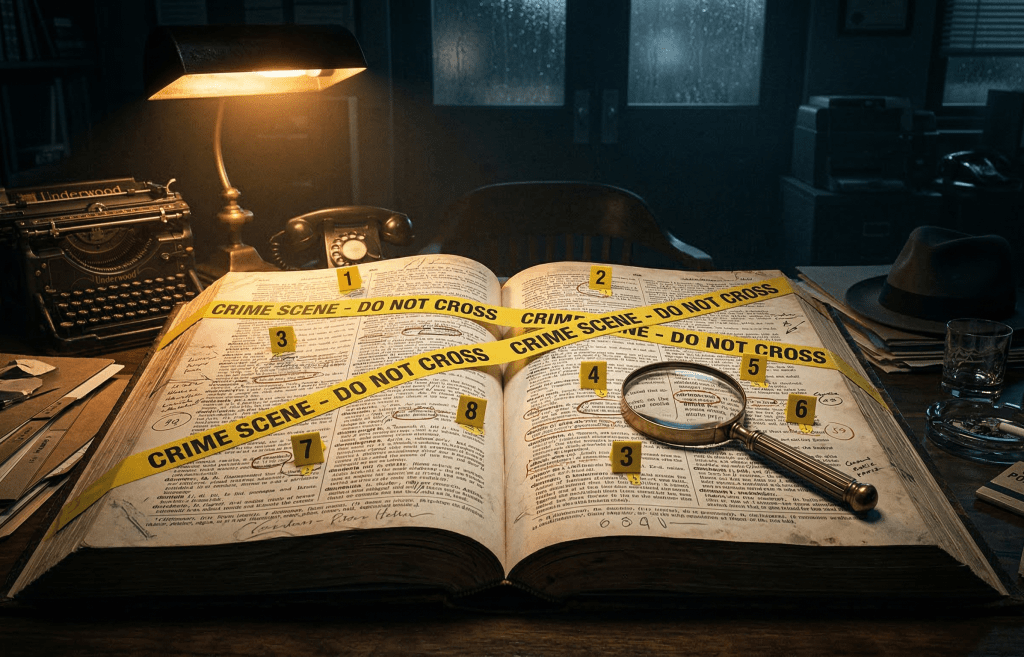
    Every word you have ever said is a corpse with a previous life and nobody is conducting the investigation.

    I found this out on a Tuesday, which is itself named after Tyr, the Norse god who lost his hand to a wolf, which means every Tuesday you are walking around inside a day named after a man who got his hand bitten off by a cosmic predator and nobody mentions this. Nobody says “happy wolf-bite day.” Nobody acknowledges that the calendar is a graveyard of dead gods dressed up as productivity. Tuesday just sits there, looking innocent, wearing a suit, pretending it doesn’t have a wolf problem.

    I started pulling threads. This was a mistake. You should not pull threads in a language because the whole thing unravels and then you’re standing in a room full of yarn screaming about Latin roots at people who came here to have a normal conversation.

    The word “belong.” It showed up in a post I wrote that nobody liked. Zero likes. Sixty-six impressions. The post said that “belong” comes from Old English, meaning intense longing. That you belong somewhere because something in you reaches toward it. This is true. This is etymologically accurate. And apparently the internet does not care about etymological accuracy at 3 p.m. on a Sunday. But I care. I care because the word “belong” has been lying to us. We use it like a filing system. “This belongs here.” “I belong to this group.” “Where does this belong?” As if belonging is a matter of location. As if it’s a drawer you put something in. But the word itself, the bones underneath the skin, says belonging is an ache. A longing so intense it becomes identity. You don’t belong somewhere because you were assigned there. You belong somewhere because the wanting changed you into a person who couldn’t be anywhere else. Every time someone says “I don’t belong here” they are etymologically saying “I don’t long for this place,” and they’re right, and the word knew it, and nobody asked the word.

    This is what happens when you let usage define meaning instead of the other way around. Usage is a game of telephone played across centuries by people who didn’t read the manual. The word starts with a precise meaning, a surgical meaning, a meaning that cuts exactly where it needs to cut. Then someone uses it loosely. Then someone else hears the loose version and uses it looser. Then the loose version becomes the meaning and the original meaning gets buried and the word walks around like a person with amnesia, doing a job it doesn’t remember applying for.

    The biblical scholars know this. They’ve been fighting about translation for two thousand years because they understand that when you change a word, you change a world. “Virgin” or “young woman.” “Charity” or “love.” “Repent” or “turn around.” Each substitution is a fork in the road that sends millions of people in different directions, and the people walking down each fork are convinced they’re on the same road because the sentence looks the same from a distance. It doesn’t look the same up close. Up close, the difference between “love” and “charity” is the difference between a fire and a tax deduction.

    Now. Possess.

    I have been waiting to talk about this word the way a man waits to show you the weird thing he found in his basement.

    “Possess” comes from Latin. Potis, meaning able, powerful. Sedēre, meaning to sit. To possess something is to sit on it in a position of power. Not to own it on paper. Not to hold the title. To physically sit on top of a thing and dare someone to move you. That’s ownership. That’s the original contract. You possess what you can sit on. Your possessions are the things underneath you. The word is a throne, not a receipt.

    And then the word flips. Demonic possession. The same word. The same Latin bones. But now the thing is sitting on you. Now you are the chair. The power reversed and the word didn’t change and the fact that it didn’t change is the most honest thing about it, because the word was always saying that the relationship between possessor and possessed runs both ways. You sit on your possessions and your possessions sit on you and the word has been screaming this from inside the dictionary for centuries and we keep nodding and saying “yes, I possess a car” without noticing that the car also possesses us, that we build garages for it and pay insurance on it and wash it on Saturdays and rearrange our entire geography around its needs, and at some point the question of who is sitting on whom becomes genuinely difficult to answer.

    And then the word flips again. “A possessing quality.” She possesses the room. He has a possessing presence. Now nobody is sitting on anything. The power is ambient. It radiates from a person the way heat radiates from a thing you shouldn’t touch. And the word is still the same word. Still the Latin bones. Still someone seated in power over someone else. But the sitting has become metaphorical and the power has become atmospheric and the word has traveled from a throne to a demon to a feeling you get when someone walks into a room and you forget what you were saying, and all three meanings are the same meaning wearing different clothes and the word knows this and you didn’t and now you do.

    “Understand.” Under. Stand. To stand beneath something. Comprehension was originally an act of submission. You didn’t understand a thing by climbing above it and looking down. You understood it by getting underneath it and letting it be over you. Letting it be bigger than you. The word says that knowledge is not domination. Knowledge is the willingness to be smaller than the thing you’re trying to know. Every time someone says “I don’t understand” they are etymologically saying “I can’t get beneath this” and they are accidentally more honest than they intend to be.

    “Disaster.” Dis plus astro. A bad star. We used to blame the sky. When something terrible happened, it was because the stars were in the wrong position, which means the word “disaster” is a fossilized prayer, a two-thousand-year-old gesture of pointing upward and saying “that one. That star. That’s the one that did this to me.” We don’t believe in astrology anymore but we still use the word and the word still believes.

    “Mortgage.” Morte plus gage. A death pledge. Not a metaphor. Not dark humor. The original term. You sign a mortgage and you are making a pledge that dies when the debt is paid or when you are, whichever comes first. Every banker who has ever handed you a mortgage document has handed you a piece of paper with the word “death” in its name and smiled while doing it and the word sits there on the dotted line, grinning, knowing its own history, waiting for you to look it up.

    I keep finding these. I can’t stop finding these. The language is a crime scene and every word is a body and every body has a story and nobody is asking questions. We walk across the crime scene every day, speaking the dead like they’re furniture, stepping over etymologies that would change the sentence if we heard them, and the words let us. The words don’t complain. They just lie there, carrying their histories inside them like organs, still functioning, still pumping the old blood, even as we use them to order coffee and argue about parking and say “I love you” without knowing that “love” comes from a root meaning “desire” which comes from a root meaning “to be lost” which means every time you say I love you, the language underneath is saying I am lost because of you, and that’s either the most beautiful thing a word has ever done or the most devastating, and the difference depends on whether you’re the one saying it or the one hearing it, and the word doesn’t care, the word just sits there, on its throne, possessed by its own history, longing for someone to finally look it up.
  • A Field Guide to Haunted English

    A Field Guide to Haunted English

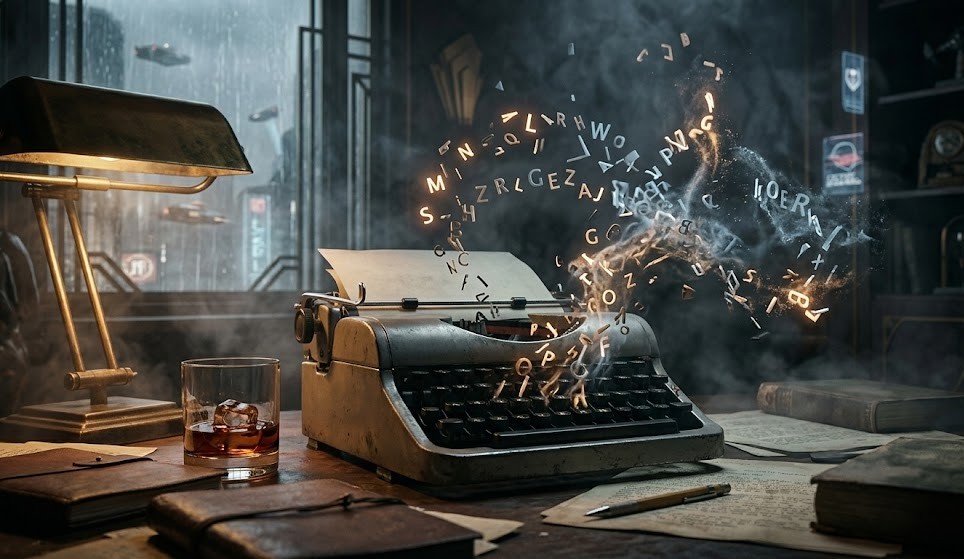
    I was three whiskeys into a Wednesday when the English language tried to kill me.

    It started with a text I didn’t send. I typed “if” and my phone autocorrected it to “is” and suddenly I had committed to something I was still negotiating. This is the problem. This has always been the problem. Is and if are separated by a single letter and an entire theology and my phone does not respect the difference. Nobody does. Is shows up with its whole chest. If keeps its jacket on. One of them built the church. The other one is circling the parking lot, has been circling the parking lot, will die circling the parking lot, because commitment is a vowel sound it cannot make. The sexual tension between these two words has been fueling all of literature and most of the rent I’ve paid on apartments I stayed in too long and I am not going to explain that further because if you felt it you felt it and if you didn’t I can’t help you and the fact that I just used both words in the same sentence and they’re doing completely different things should alarm someone.

    Nobody is alarmed.

    I went to a dinner party. I don’t know why I go to dinner parties. At this one, a man pronounced it plEthora and a woman pronounced it plethOra and for eleven seconds the room contained two separate realities and no one acknowledged it. I stood there holding a glass of something that had been described to me and realized this wasn’t a disagreement. This was a border dispute. Two nations sharing a word and refusing to share a flag. The man who says plEthora went to a college where people corrected each other. The woman who says plethOra learned it from Three Amigos. Both correct. Neither will back down. And if you listen, really listen, the pronunciation someone chooses tells you more about their childhood than any memoir. It tells you which books were in the house. Whether the television was an authority or a guest. The mouth remembers what the mind has edited and the mouth does not care about your rebrand.

    I left the party early. On the way home I tried to use faux pas in a sentence and nearly drove off the road.

    A sincere phonetically accurate pronunciation of faux pas sounds like someone falling down a flight of stairs in a language they don’t speak. Fawx pass. I said it out loud in the car. The car did not judge me. The car is the only safe space left for language. You can say anything in a car. You can pronounce faux pas like an American, which is what it is, in your mouth, right now, an American word wearing a beret it bought at the airport. English swallowed this phrase from French centuries ago and has been pretending to know what to do with it ever since. The whole arrangement is a man who stole a tuxedo and now has to attend the opera and he’s sweating through the shirt and smiling and the word, the word itself, means false step, which means pronouncing it correctly is a performance of not making a false step, which means the word about social failure can only be spoken by someone performing social success, which means it undermines itself every time someone gets it right and fulfills its own prophecy every time someone gets it wrong, and I am in my car yelling FAWX PASS at the windshield and the windshield is taking it.

    The language is haunted. I have been saying this to people. They do not invite me to dinner parties because of this but also I keep showing up. Every word drags behind it the corpse of every previous use and the corpse is not dead, it is pretending, and when you open your mouth the corpse sits up and says something you didn’t authorize. This is why you have said “I’m fine” in a tone of voice that means “I am disintegrating from the feet up.” The words were correct. The haunting was louder. The haunting is always louder.

    And now it’s later, or maybe it’s earlier, the timeline has become unreliable, and someone at a different party, or possibly the same party on a different night, is telling me about the Mandela effect, and I am nodding, and what I am actually thinking is that misremembering might be the most honest thing a mouth can do. That consensus pronunciation is a treaty nobody signed. That reality is a draft, not a publication, and enough people remembering it wrong is functionally the same as it having been different, and the Mandela effect is not a glitch, it’s a peer review that came back with edits, and the original author is furious, and the reviewers have already left the building, and the word is sitting on the page meaning two things at once and belonging to nobody.

    I got home. I typed something into my phone. My phone corrected it. I corrected my phone. My phone corrected my correction. We went back and forth like this for a while, two opposing theologies trapped in a device that fits in my pocket, and eventually I gave up and sent the message and it said what it said and not what I meant and the difference between those two things is a single letter and an entire religion and the parking lot is still being circled and the church is still being built and the tuxedo does not fit and never did and I said fawx pass one more time, quietly, to no one, and no one corrected me, and it was the truest thing I’d said all night.

  • The Clock Is Drunk

    The Clock Is Drunk

    I lost February. I don’t mean it was short. I mean it left. One moment I was standing inside it and the next I was standing in March wearing the same pants and holding a coffee that had gone cold during a month I apparently attended but cannot account for. January, I remember. January lasted eleven years. Every week in January was a geological epoch. I aged visibly between Mondays. I developed opinions about oatmeal. I watched the same four walls perform a one-man show about endurance and I gave it three stars because it had no intermission. January was the kind of month that makes you check the calendar and then check it again because surely more time has passed than that, surely you have suffered enough for it to be at least April.

    And then February started, and I blinked, and the blink had a month inside it, and now I’m here.

    Does anybody really know what time it is?

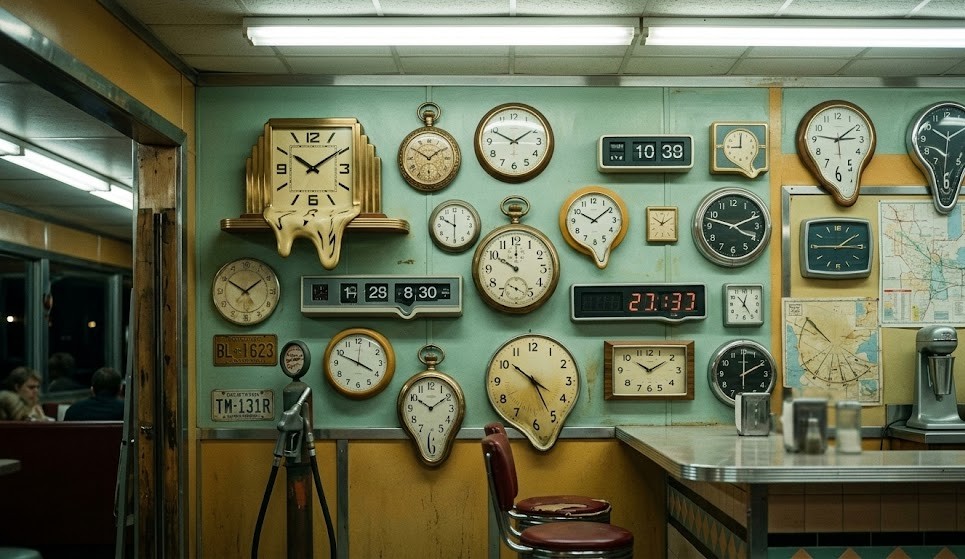
    I asked this at a gas station. The man behind the counter looked at me like I had asked him to explain the moon. Which, fair. But I wasn’t being philosophical. I was being practical. My phone said 2:14. The clock on the wall said 3:07. The receipt said 1:58. Three machines in the same room, all powered by the same electrical grid, all connected to the same satellites, and not one of them could agree on when it was. This is the infrastructure. This is what we’ve built. A civilization of clocks that cannot keep time, arguing with each other on your behalf while you stand there holding a bag of peanuts and wondering if the afternoon has already happened or if it’s still pending.

    You don’t know what day it is either. I know you don’t. I can tell by the way you looked at your phone just now. You looked at it the way you look at a friend who owes you money. You looked at it hoping it would tell you something you could use and it told you a number and the number meant nothing. Wednesday. Is it Wednesday? It feels like Wednesday. It also feels like Friday and like a Sunday that got lost and ended up in the middle of the week wearing someone else’s name. The days are not organized. They are a drawer full of socks that used to match and now you just grab two and hope nobody looks down.

    I had a meeting yesterday. Or the day before. The meeting was about the future. Everyone in the meeting was very concerned about the future. They had slides. The slides had timelines. The timelines had quarters and the quarters had goals and the goals had deadlines and every single person in that room was pretending they knew what month it was. I sat there nodding. I have gotten very good at nodding. Nodding is the only skill that transfers across all temporal zones. You can nod in January. You can nod in whatever we’re calling this. You can nod at a gas station at a time that three different clocks cannot agree on and the nod still works. The nod is the universal constant. Not the speed of light. The nod.

    The slides said Q2. I wrote down Q2. I underlined it. I do not know when Q2 is. I know it comes after Q1 the way Wednesday comes after Tuesday, which is to say technically, on paper, in a system that somebody designed and the rest of us pretend to inhabit. But the system is drunk. The calendar is a suggestion that got laminated and hung on a wall and everyone agreed to take it seriously and nobody asked why. We all walk around carrying the same twelve-month hallucination and getting upset when it doesn’t match the way time actually feels, which is: January is a prison sentence. February is a rumor. March is the moment you realize you’ve been holding your breath and you don’t remember starting.

    The world may explode at any second and you’re still talking about tomorrow.

    That’s the part I can’t get over. The future tense. We use it constantly. We use it like it’s a place we can visit, like it’s a room at the end of the hall that we’ll get to eventually if we keep walking. “I’ll do it tomorrow.” “We’ll revisit this next quarter.” “Let’s circle back.” Circle back. As if time is a loop you can reenter. As if the meeting you missed is still happening somewhere and you just need to find the right hallway. The future tense is the biggest bluff in the language. It is a check written on an account that may or may not exist by the time the check clears, and we write them constantly, dozens a day, convinced that the bank will still be open tomorrow, which is itself a future-tense proposition, which means the whole operation is a pyramid scheme running on grammar and good faith.

    I got home. It was dark. It is always dark when I get home now, or it is still light, and the difference between those two things is a season I cannot locate on the calendar because the calendar and I are no longer speaking. I sat on the couch. I looked at my phone. My phone said it was a time. I chose to believe it. Not because I trusted it but because the alternative is standing in a gas station asking a stranger to explain the moon and I have already done that once this week. Or last week. Or during that part of February that apparently happened while I was blinking.

    The coffee is cold again. It keeps doing this. I keep making it hot and it keeps becoming cold and the process by which it transitions from one to the other is called time and I am beginning to suspect that time is not a force or a dimension or a river or any of the metaphors we use to make it behave. Time is a gas station clerk who doesn’t know the answer either but has to say something because you’re standing there, holding peanuts, waiting.

  • Fortune Cookie Factory

    Fortune Cookie Factory

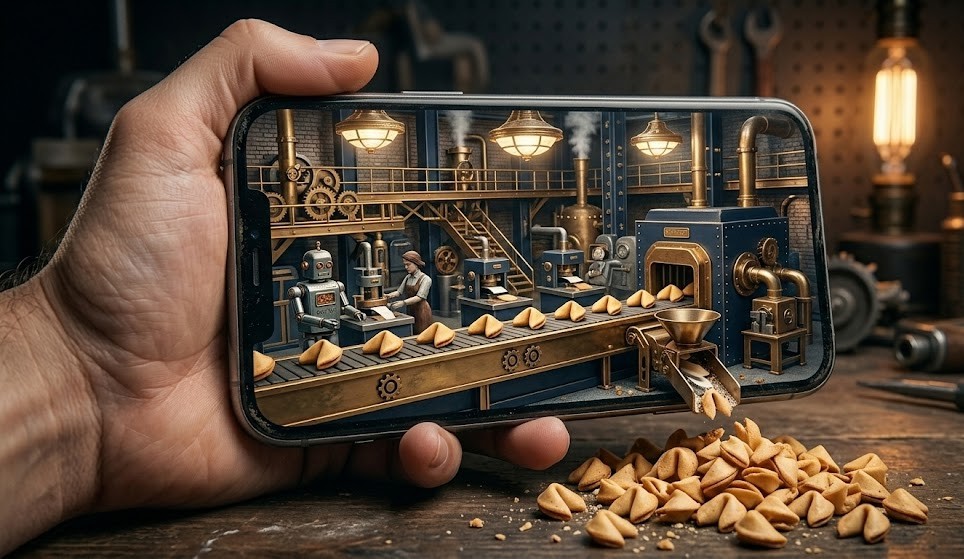
    I have been running a fortune cookie factory out of a phone screen for approximately six months and nobody has called the health inspector.

    The operation is simple. I sit somewhere. A thought arrives. I compress the thought until it fits inside a sentence. I put the sentence on the internet. People open it. Some of them nod. Some of them save it for later, which means they put my sentence inside their phone, which means my thought is now living rent-free in a device that belongs to a stranger, which means I have broken into someone’s pocket using only grammar, which is either publishing or a very slow home invasion and I am not qualified to determine which.

    The product is fortune cookies. I know this because someone told me. They said my feed reads like a fortune cookie factory run by a philosopher who’s also funny, and I wrote that down, because when someone describes your entire operation in a single sentence you don’t argue with it. You laminate it. You tape it to the wall of the factory next to the other fortunes and you keep pulling the lever.

    The factory has no hours. The factory has no walls. The factory is wherever I am when a sentence shows up fully formed and demands to exist. I have manufactured fortunes in parking lots. I have manufactured fortunes during conference calls where someone was explaining Q2 and I was not listening because a seven-word thought about loneliness had just walked into my head wearing a hat and I had to deal with it immediately or it would leave and I would spend the rest of the day knowing I had something and let it go. The sentences do not wait. They are not polite. They show up, they stand in the doorway, and if you don’t write them down in the next eleven seconds they leave and they do not come back and you will never prove they were there.

    This is the job. I did not apply for this job. The job applied for me.

    The platform is called X, which used to be called Twitter, which used to be called something people enjoyed saying out loud. Now it is called a letter. The letter X. As in: solve for. As in: the variable. As in: nobody knows what this place is anymore and the name finally reflects that. I operate inside it the way someone operates inside a hotel lobby. I am not a guest. I am not staff. I am sitting in the cafe in the lobby, watching people check in and check out, and occasionally I say something from my table and the acoustics carry it further than either of us expected.

    There are people in this lobby paying for attention. I know this because the economics are visible if you sit still long enough. Attention is the currency. Not money. Not clout. Attention. Raw, uncut, mainlined attention, measured in impressions, which is a word that means “the number of times your sentence appeared on a screen” and also a word that means “the mark left by pressing one thing into another.” Both definitions are operating simultaneously and nobody acknowledges this. Every time your post gets an impression, you have pressed yourself into a stranger. Every time you scroll past someone’s post without stopping, you have received an impression you did not process. The lobby is full of people pressing themselves into each other and not stopping and the cafe is full of coffee I did not order and fortune cookies I cannot stop making.

    Paying attention versus paying for attention. That’s the whole economy. One of them costs you time. The other costs you money. One of them is a gift you give with your eyeballs. The other is a receipt. And the platform cannot tell the difference. The platform counts both the same way. The algorithm sees a pair of eyes that lingered for four seconds and a pair of eyes that were purchased for four cents and it calls them the same thing and files them in the same column and the column is called engagement, which is also what you call it when two people decide to get married, which means the algorithm thinks your eyeballs just proposed to my sentence and I don’t know what to do with that information except put it in a fortune cookie and pull the lever again.

    I scroll your media sometimes. Not to spy. To study. The media tab on someone’s profile is the truest thing about them. Not the bio. Not the pinned tweet. The media tab. It’s every image they chose to attach to a thought, arranged in a grid, and the grid is a portrait the person did not know they were sitting for. You can see what someone finds beautiful. You can see what they find funny. You can see the exact ratio of sincerity to irony in their visual diet and the ratio tells you everything the bio was trying to hide. Scrolling someone’s media is reading their diary through the pictures they taped to the cover. Nobody talks about this. Everybody does it.

    The fortune cookie factory is still running. It runs at night. It runs during meals. It runs in the shower, which is inconvenient, because the sentences arrive wet and urgent and by the time I’ve dried off enough to type, half of them have dissolved. The ones that survive are the ones that were strong enough to wait. Those are the ones that end up in your feed at 11 p.m. when you should be asleep but you’re not, you’re scrolling, you’re in the lobby, and a sentence from a stranger’s table reaches you across the room and you stop for four seconds and the algorithm files it and I have pressed myself into you again and neither of us asked for this and both of us are still here.

    Pull the lever. Crack the cookie. Read the fortune. Throw the cookie away. Everyone does. Nobody eats the cookie. The cookie was never the point.