The Hofflebrock

Tag: language

  • Chamath

    Chamath

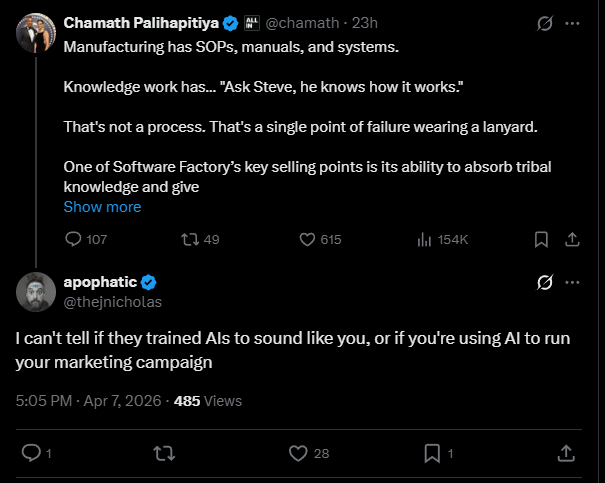
    I was three scrolls into an X session I had already promised myself I wouldn’t have when Chamath Palihapitiya appeared on my screen and said something about manufacturing having SOPs and knowledge work having Steve, and Steve is a single point of failure wearing a lanyard, and I stopped scrolling because the sentence sounded like something I had heard before. Not the content. The shape. The way each paragraph did exactly one thing and then stopped and the next paragraph did one thing and then stopped and the rhythm was declaration, pause, pivot, sell. Declaration, pause, pivot, sell. The man was typing in iambic pentameter for venture capitalists and 154,000 people were watching and I was trying to figure out why a billionaire’s X post sounded like it had been generated by the same thing I use to outline my novel.

    I replied. I said: “I can’t tell if they trained AIs to sound like you, or if you’re using AI to run your marketing campaign.”

    Twenty-eight likes. Which on my account is a ticker-tape parade. But the reply wasn’t a joke. It was a real question I did not have the answer to, and I still don’t, and the reason I still don’t is that the answer might be that the question is broken. That “or” in the middle might be doing something it can’t actually do, which is separate two things that are no longer two things.

    I have spent months staring at a robot’s (ie AI’s) output. Not using it. Staring at it. Cataloguing the tics. The way a robot builds a paragraph with every sentence structural, no word wasted, no breath taken that doesn’t serve the whole. The way it pivots from observation to implication in exactly three moves. The way it ends with something that feels like insight but functions as a closer, a resonant little button that gives you the sensation of having learned something without requiring you to verify whether you actually did. I know this fingerprint. I have it memorized. And Chamath’s post had it. Not approximately. Not in the neighborhood. The same fingerprint.

    Maybe Chamath writes his own posts. Maybe he always has, and the reason the a robot sounds like a founder pitching at a board meeting is because the it was fed millions of words by founders pitching at board meetings and learned that this is what authority sounds like, this is what confidence sounds like, this modular rhythm is the sound of a person who has money telling a person who wants money how the world works. That’s one version. The other version is Chamath uses a robot to write his posts, or to polish them, or to “refine his ideas” which is the phrase people use when they mean “I typed a sentence and the machine wrote the other eleven,” and if that’s the case then the circularity is total. The model learned his voice from his corpus. He uses the model to generate new corpus. The model will retrain on the generated corpus. And the signal folds in on itself, getting smaller and tighter and more compressed until you can’t find the original crease because the original crease has been folded into the fold that was folded into the fold.

    Or both are true simultaneously and the distinction has collapsed. Not “collapsed” like it fell apart. “Collapsed” like a wave function. The observation changed the state. The moment the robots learned to sound like the optimization class, the optimization class started sounding like the robots, and now neither of them is the original and both of them are the copy and the word “copy” doesn’t mean anything anymore because a copy requires an original, and the original is a founder’s X post from 2019 that got scraped into a training set that produced a model that now writes the posts that will get scraped into the next training set, and the snake has eaten enough of its own tail that the snake is now mostly tail.

    A year ago, “sounds like AI” meant something specific. It meant that weird ChatGPT voice. “Certainly! Here’s a comprehensive overview.” “Let’s delve into.” “It’s important to note.” A dialect so distinct you could spot it from across a room. But that dialect is dying. Not because AI got worse at it but because it got better. The new dialect doesn’t announce itself. It doesn’t say “certainly” or “let’s delve.” It says things like “that’s a single point of failure wearing a lanyard.” It claims every point you make is “load-bearing.” It sounds like a person. It sounds like a specific kind of person. It sounds like the kind of person whose communication has been optimized for engagement since before the models existed, because those people were the training data, and the training data is the voice, and the voice is now everywhere, and the voice sounds like competence, and we are so used to associating that particular cadence with intelligence that we can’t hear it anymore, the way you stop hearing the highway when you’ve lived next to it long enough, except this highway is carrying every thought you read and half the ones you write.

    I kept coming back to my own reply, and the thing that started bothering me was that I couldn’t tell if I wrote it, or if I wrote the version of it that months of talking to the robots trained me to write. My sentence had a rhythm too. It had a pivot. It had a structure that looked a lot like the structures I’ve been absorbing through the screen, and the contamination might not be one-directional, it might not be Chamath’s problem or the robot’s problem, it might be my problem, which means it’s your problem, which means the question in my reply wasn’t a question about Chamath at all.

    It was a question about whether anyone is still writing from scratch or whether we’re all running on the same borrowed firmware now, all sounding the same, all pivoting at the same beat, all landing on the same resonant little button at the end of the paragraph, and the button doesn’t mean anything, and nobody notices, because the button feels like insight, and feeling like insight has replaced the need for insight to actually be there.

  • The Dictionary Is a Crime Scene

    The Dictionary Is a Crime Scene

    Every word you have ever said is a corpse with a previous life and nobody is conducting the investigation.

    I found this out on a Tuesday, which is itself named after Tyr, the Norse god who lost his hand to a wolf, which means every Tuesday you are walking around inside a day named after a man who got his hand bitten off by a cosmic predator and nobody mentions this. Nobody says “happy wolf-bite day.” Nobody acknowledges that the calendar is a graveyard of dead gods dressed up as productivity. Tuesday just sits there, looking innocent, wearing a suit, pretending it doesn’t have a wolf problem.

    I started pulling threads. This was a mistake. You should not pull threads in a language because the whole thing unravels and then you’re standing in a room full of yarn screaming about Latin roots at people who came here to have a normal conversation.

    The word “belong.” It showed up in a post I wrote that nobody liked. Zero likes. Sixty-six impressions. The post said that “belong” comes from Old English, meaning intense longing. That you belong somewhere because something in you reaches toward it. This is true. This is etymologically accurate. And apparently the internet does not care about etymological accuracy at 3 p.m. on a Sunday. But I care. I care because the word “belong” has been lying to us. We use it like a filing system. “This belongs here.” “I belong to this group.” “Where does this belong?” As if belonging is a matter of location. As if it’s a drawer you put something in. But the word itself, the bones underneath the skin, says belonging is an ache. A longing so intense it becomes identity. You don’t belong somewhere because you were assigned there. You belong somewhere because the wanting changed you into a person who couldn’t be anywhere else. Every time someone says “I don’t belong here” they are etymologically saying “I don’t long for this place,” and they’re right, and the word knew it, and nobody asked the word.

    This is what happens when you let usage define meaning instead of the other way around. Usage is a game of telephone played across centuries by people who didn’t read the manual. The word starts with a precise meaning, a surgical meaning, a meaning that cuts exactly where it needs to cut. Then someone uses it loosely. Then someone else hears the loose version and uses it looser. Then the loose version becomes the meaning and the original meaning gets buried and the word walks around like a person with amnesia, doing a job it doesn’t remember applying for.

    The biblical scholars know this. They’ve been fighting about translation for two thousand years because they understand that when you change a word, you change a world. “Virgin” or “young woman.” “Charity” or “love.” “Repent” or “turn around.” Each substitution is a fork in the road that sends millions of people in different directions, and the people walking down each fork are convinced they’re on the same road because the sentence looks the same from a distance. It doesn’t look the same up close. Up close, the difference between “love” and “charity” is the difference between a fire and a tax deduction.

    Now. Possess.

    I have been waiting to talk about this word the way a man waits to show you the weird thing he found in his basement.

    “Possess” comes from Latin. Potis, meaning able, powerful. Sedēre, meaning to sit. To possess something is to sit on it in a position of power. Not to own it on paper. Not to hold the title. To physically sit on top of a thing and dare someone to move you. That’s ownership. That’s the original contract. You possess what you can sit on. Your possessions are the things underneath you. The word is a throne, not a receipt.

    And then the word flips. Demonic possession. The same word. The same Latin bones. But now the thing is sitting on you. Now you are the chair. The power reversed and the word didn’t change and the fact that it didn’t change is the most honest thing about it, because the word was always saying that the relationship between possessor and possessed runs both ways. You sit on your possessions and your possessions sit on you and the word has been screaming this from inside the dictionary for centuries and we keep nodding and saying “yes, I possess a car” without noticing that the car also possesses us, that we build garages for it and pay insurance on it and wash it on Saturdays and rearrange our entire geography around its needs, and at some point the question of who is sitting on whom becomes genuinely difficult to answer.

    And then the word flips again. “A possessing quality.” She possesses the room. He has a possessing presence. Now nobody is sitting on anything. The power is ambient. It radiates from a person the way heat radiates from a thing you shouldn’t touch. And the word is still the same word. Still the Latin bones. Still someone seated in power over someone else. But the sitting has become metaphorical and the power has become atmospheric and the word has traveled from a throne to a demon to a feeling you get when someone walks into a room and you forget what you were saying, and all three meanings are the same meaning wearing different clothes and the word knows this and you didn’t and now you do.

    “Understand.” Under. Stand. To stand beneath something. Comprehension was originally an act of submission. You didn’t understand a thing by climbing above it and looking down. You understood it by getting underneath it and letting it be over you. Letting it be bigger than you. The word says that knowledge is not domination. Knowledge is the willingness to be smaller than the thing you’re trying to know. Every time someone says “I don’t understand” they are etymologically saying “I can’t get beneath this” and they are accidentally more honest than they intend to be.

    “Disaster.” Dis plus astro. A bad star. We used to blame the sky. When something terrible happened, it was because the stars were in the wrong position, which means the word “disaster” is a fossilized prayer, a two-thousand-year-old gesture of pointing upward and saying “that one. That star. That’s the one that did this to me.” We don’t believe in astrology anymore but we still use the word and the word still believes.

    “Mortgage.” Morte plus gage. A death pledge. Not a metaphor. Not dark humor. The original term. You sign a mortgage and you are making a pledge that dies when the debt is paid or when you are, whichever comes first. Every banker who has ever handed you a mortgage document has handed you a piece of paper with the word “death” in its name and smiled while doing it and the word sits there on the dotted line, grinning, knowing its own history, waiting for you to look it up.

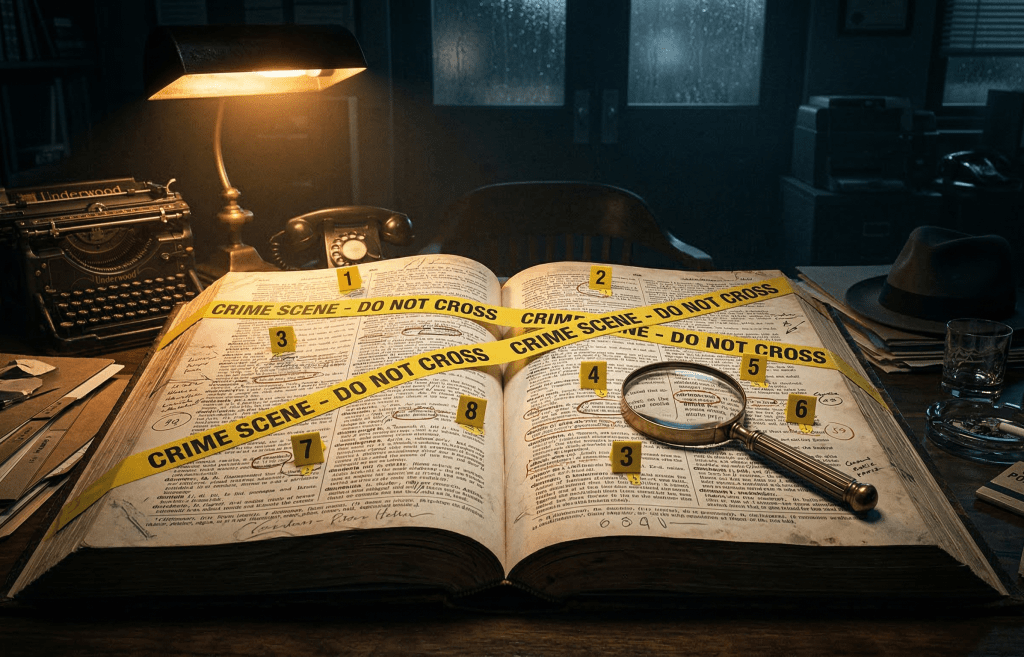
    I keep finding these. I can’t stop finding these. The language is a crime scene and every word is a body and every body has a story and nobody is asking questions. We walk across the crime scene every day, speaking the dead like they’re furniture, stepping over etymologies that would change the sentence if we heard them, and the words let us. The words don’t complain. They just lie there, carrying their histories inside them like organs, still functioning, still pumping the old blood, even as we use them to order coffee and argue about parking and say “I love you” without knowing that “love” comes from a root meaning “desire” which comes from a root meaning “to be lost” which means every time you say I love you, the language underneath is saying I am lost because of you, and that’s either the most beautiful thing a word has ever done or the most devastating, and the difference depends on whether you’re the one saying it or the one hearing it, and the word doesn’t care, the word just sits there, on its throne, possessed by its own history, longing for someone to finally look it up.

  • A Field Guide to Haunted English

    A Field Guide to Haunted English

    I was three whiskeys into a Wednesday when the English language tried to kill me.

    It started with a text I didn’t send. I typed “if” and my phone autocorrected it to “is” and suddenly I had committed to something I was still negotiating. This is the problem. This has always been the problem. Is and if are separated by a single letter and an entire theology and my phone does not respect the difference. Nobody does. Is shows up with its whole chest. If keeps its jacket on. One of them built the church. The other one is circling the parking lot, has been circling the parking lot, will die circling the parking lot, because commitment is a vowel sound it cannot make. The sexual tension between these two words has been fueling all of literature and most of the rent I’ve paid on apartments I stayed in too long and I am not going to explain that further because if you felt it you felt it and if you didn’t I can’t help you and the fact that I just used both words in the same sentence and they’re doing completely different things should alarm someone.

    Nobody is alarmed.

    I went to a dinner party. I don’t know why I go to dinner parties. At this one, a man pronounced it plEthora and a woman pronounced it plethOra and for eleven seconds the room contained two separate realities and no one acknowledged it. I stood there holding a glass of something that had been described to me and realized this wasn’t a disagreement. This was a border dispute. Two nations sharing a word and refusing to share a flag. The man who says plEthora went to a college where people corrected each other. The woman who says plethOra learned it from Three Amigos. Both correct. Neither will back down. And if you listen, really listen, the pronunciation someone chooses tells you more about their childhood than any memoir. It tells you which books were in the house. Whether the television was an authority or a guest. The mouth remembers what the mind has edited and the mouth does not care about your rebrand.

    I left the party early. On the way home I tried to use faux pas in a sentence and nearly drove off the road.

    A sincere phonetically accurate pronunciation of faux pas sounds like someone falling down a flight of stairs in a language they don’t speak. Fawx pass. I said it out loud in the car. The car did not judge me. The car is the only safe space left for language. You can say anything in a car. You can pronounce faux pas like an American, which is what it is, in your mouth, right now, an American word wearing a beret it bought at the airport. English swallowed this phrase from French centuries ago and has been pretending to know what to do with it ever since. The whole arrangement is a man who stole a tuxedo and now has to attend the opera and he’s sweating through the shirt and smiling and the word, the word itself, means false step, which means pronouncing it correctly is a performance of not making a false step, which means the word about social failure can only be spoken by someone performing social success, which means it undermines itself every time someone gets it right and fulfills its own prophecy every time someone gets it wrong, and I am in my car yelling FAWX PASS at the windshield and the windshield is taking it.

    The language is haunted. I have been saying this to people. They do not invite me to dinner parties because of this but also I keep showing up. Every word drags behind it the corpse of every previous use and the corpse is not dead, it is pretending, and when you open your mouth the corpse sits up and says something you didn’t authorize. This is why you have said “I’m fine” in a tone of voice that means “I am disintegrating from the feet up.” The words were correct. The haunting was louder. The haunting is always louder.

    And now it’s later, or maybe it’s earlier, the timeline has become unreliable, and someone at a different party, or possibly the same party on a different night, is telling me about the Mandela effect, and I am nodding, and what I am actually thinking is that misremembering might be the most honest thing a mouth can do. That consensus pronunciation is a treaty nobody signed. That reality is a draft, not a publication, and enough people remembering it wrong is functionally the same as it having been different, and the Mandela effect is not a glitch, it’s a peer review that came back with edits, and the original author is furious, and the reviewers have already left the building, and the word is sitting on the page meaning two things at once and belonging to nobody.

    I got home. I typed something into my phone. My phone corrected it. I corrected my phone. My phone corrected my correction. We went back and forth like this for a while, two opposing theologies trapped in a device that fits in my pocket, and eventually I gave up and sent the message and it said what it said and not what I meant and the difference between those two things is a single letter and an entire religion and the parking lot is still being circled and the church is still being built and the tuxedo does not fit and never did and I said fawx pass one more time, quietly, to no one, and no one corrected me, and it was the truest thing I’d said all night.