The Hofflebrock

Tag: Systems Thinking

  • The Fire Started Itself

    The Fire Started Itself

    The world is on fire and nobody lit it. That’s the part that bothers me. Not the fire. The fire I can work with. Fire is at least a thing. Fire has behavior. You can study fire. You can stand at a reasonable distance and take notes on fire. What you cannot do is find the person who started it, because there is no person, because the fire started itself, and a fire that started itself does not have demands and cannot be negotiated with and does not care about your timeline for when it should stop.

    I keep watching people look for the arsonist. This is the main activity now. Identifying who lit it. Was it the billionaires. Was it the algorithms. Was it the other political party. Was it the generation before us or the generation after us or the specific generation currently in charge of the specific institution currently producing the most smoke. Everyone is standing in a burning building arguing about the origin point while the ceiling develops opinions about gravity, and I am standing in the corner thinking: what if nobody lit it. What if the building was always going to burn. What if the materials were wrong from the start and the structure was stressed in places nobody checked and the fire is not an event but a consequence and the consequence has been arriving in slow motion for decades and we just didn’t call it fire until we could feel the heat.

    This does not help. Knowing the fire started itself does not help put the fire out. But it does change what you do next. Because if someone lit it, you find them and you stop them. That’s a quest. That has a villain and a resolution and a shape you can hold in your hands. But if the fire started itself, there’s no villain. There’s no quest. There’s just a burning room and you, in it, deciding what to do with the fact that the room is smaller than it was yesterday and will be smaller again tomorrow.

    Describe an unseen shape.

    I keep coming back to this. Not as poetry. As instructions. The shape I can see is the fire. The shape I can’t see is what the fire is revealing. Because fire does that. It removes. It takes away walls and ceilings and assumptions and the furniture you forgot you’d arranged your life around, and when it’s done, if you’re still standing, the room is a different room. Not because something was added. Because something was taken away. And the thing that was taken away was blocking your view of something you didn’t know was there.

    Building something versus removing what’s hiding it. That’s the question and I don’t think most people realize there are two options. The default response to a fire is to rebuild. Get the plans. Call the contractor. Put the walls back where they were. Hang the same pictures. Buy the same furniture. Rebuild the room you had, because the room you had is the room you knew, and knowing is safer than discovering. But what if the room you had was wrong. What if the walls were in the wrong place. What if the fire, which nobody started and nobody asked for, is doing the work you were never going to do yourself because you were too comfortable and too afraid and the furniture was fine, the furniture was good enough, the furniture was arranged in a way that let you move through the room without ever looking at the parts of it you’d been avoiding.

    By removing the old life, the subject creates a vacuum that pulls the new life into existence without manual labor. I wrote that during a week when three things I had built fell apart simultaneously. A relationship to a job. A version of my schedule. A belief about what I was supposed to be doing next. None of them were destroyed by enemies. None of them were taken from me. They just stopped being true. The way a fire stops needing permission. The way a structure stressed in the wrong places eventually does what stressed structures do, which is reveal where the stress was, which is information you could not have gotten any other way, which means the collapse was also a diagnosis, which means the worst week was also the most honest week, which is a hell of a thing to realize while you’re standing in the ashes of your quarterly plan.

    I am not going to tell you the fire is good. The fire is not good. The fire is fire. It is not for you or against you. It does not have a lesson plan. It is not a metaphor that resolves into personal growth if you squint at it from the right angle on a Sunday morning with enough coffee. The fire is the removal of things that were in the way and some of those things you loved and some of those things were keeping you warm and the fact that they were also blocking the door is not a comfort, it is just a fact, and facts do not care about your comfort, which is something the fire and the facts have in common.

    Every time I tried to build over the ashes without looking at what the fire had shown me, the fire came back. And every time I stopped rebuilding and started looking, really looking, at the new shape of the room, something fit that didn’t fit before. A door where a wall used to be. A window where there used to be a bookshelf full of books I’d already read. The shape was always there.

    The world is on fire. Nobody lit it. There is no arsonist to catch, no quest to complete, no villain to defeat. There is just a room that is changing shape whether you want it to or not, and the only choice is whether to keep rebuilding the old walls or stand in the new space long enough to see what it looks like without them.

    I’m standing. It looks different in here. I don’t know what it looks like yet. The smoke hasn’t cleared. But I can feel the edges of something, the way you feel a draft before you find the window, and the draft is coming from a direction the old room didn’t have.
  • The Hustle vs. The Protocol: Why Cardone’s 52 Rules Break Your Brain

    A Translation Matrix for the Neurodivergent Operator

    The Problem With Hustle Culture

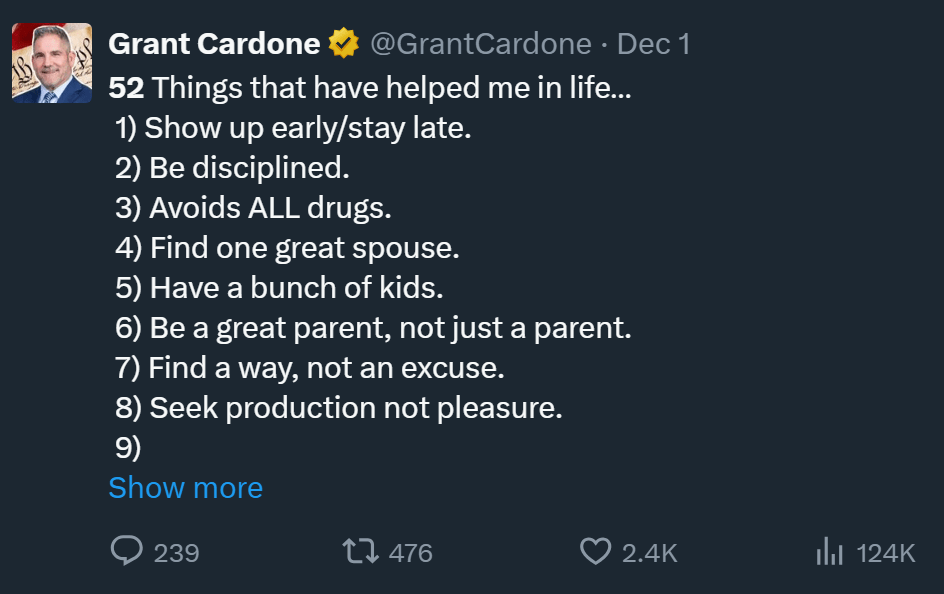
    Grant Cardone’s 52 rules for success are seductive. Work harder than everyone else. Show up early. Stay late. Find a way, not an excuse.

    For the neurotypical grinder, these are commandments. For those with ADHD, Autism, or generic Executive Dysfunction, these rules are not just ineffective. They are corrosive.

    The core assumption of hustle culture is that willpower is the only variable. It assumes energy is infinite. It assumes that if you are not succeeding, you are simply not trying hard enough.

    This is neurotypical mythology.

    For those operating on the Bathys Protocol (a framework designed for finite executive function), we require a different approach. We need systems that manage the load rather than mantras that shame the limitations.

    This is not a rejection of Cardone’s ambition. It is a recompilation for a different operating system.

    Executive Function is Voltage

    Traditional productivity advice treats the brain as a binary switch. You are either disciplined or lazy. You either hustle or you make excuses.

    Neuroscience offers a different schematic. Executive function operates as voltage. You possess a finite charge each day. Complex tasks drain it. Decision fatigue compounds it. When you hit zero, motivational speeches do not restore the charge. Recovery does.

    The Bathys Protocol recognizes this reality. It builds on three pillars:

    1. Density over Duration: Compress work into high-efficiency blocks.
    2. Diagnostics over Guilt: Identify the constraint rather than the moral failing.
    3. Leverage over Labor: Scale systems. Do not scale hours.

    The Translation Matrix

    We do not discard the 52 rules. We translate them. Here are the critical reframes.

    Rule #1: “Show up early / Stay late”

    • The Trap: Sensory burnout. For the neurodivergent professional, physical presence in a retail or office environment drains voltage without increasing output. You confuse attendance with productivity.
    • The Protocol: Density over Duration. Compress the workload. Use asynchronous prep to load tomorrow’s decisions today. Automate the close. High-impact work blocks beat loitering time.

    Rule #7: “Find a way, not an excuse”

    • The Trap: The shame spiral. When executive dysfunction hits, labeling it an “excuse” causes paralysis. You cannot force your way through a dopamine deficit.
    • The Protocol: Diagnostics Over Guilt. Is it a lack of skill? Lack of fuel? A bad process? Fix the mechanism. When you cannot focus, the problem is not your character. It is your system.

    Rule #10: “Study the greats”

    • The Trap: Mimicry. Copying surface-level behaviors of extroverted sales types leads to masking. You will burn out trying to perform a personality that does not exist.
    • The Protocol: Analyze the Source Code. Deconstruct the principles used by successful entities. Look at Jung’s shadow work or Musk’s first-principles thinking. Recompile them for your operating system.

    Rule #12: “Scale everything”

    • The Trap: Operator overload. You try to clone your personal effort linearly. You cannot make 10x more sales calls yourself without destroying your mental health.
    • The Protocol: Scale the System. Build the engine. Use SOPs, AI agents, and marketing funnels. Detach revenue from your time. The machine grows while your workload stabilizes.

    Rule #21: “Don’t make sense of nonsense”

    • The Trap: Analysis paralysis. The INTP urge to dissect irrational behavior wastes precious mental cycles.
    • The Protocol: Navigate, Don’t Debate. Acknowledge irrationality as a terrain feature. It is a rock in the road. Move around it. Save processing power for solvable problems.

    Rule #24: “Work harder than everyone else”

    • The Trap: The grinder mentality. Leading by sweat keeps you trapped in tactical weeds instead of strategic architecture.
    • The Protocol: Leverage Over Labor. Work smarter. Focus on strategic planning and dashboard creation. Build tools that multiply impact without multiplying hours.

    Rule #27: “Become a master communicator”

    • The Trap: Sales pitching. This views communication solely as extraction (closing deals).
    • The Protocol: Transmission of Clarity. Master narrative and instruction. Write clear SOPs. Focus on high-fidelity information transfer that reduces error rates.

    Rule #49: “Know you’re entitled to nothing”

    • The Trap: Nihilism. Without proper framing, this leads to a bleak outlook.
    • The Protocol: Agency is Absolute. The universe is indifferent. You are the sole architect of the outcome. This is radical responsibility. It is the elimination of victimhood.

    The Synthesis: Fuel Meets Engine

    Hustlers like Grant are the fuel. The Bathys Protocol is the engine.

    We do not discard the ambition. We discard the inefficiency. We use the pressure Cardone suggests to drive the systems we build, not to crush the operator.

    Hustle without systems leads to burnout. Systems without ambition lead to stagnation.

    Action Items

    1. Audit your voltage. What tasks deplete you disproportionately? Automate or eliminate them.
    2. Build one system. Pick the lowest-hanging fruit. An email template. A checklist. A decision tree.
    3. Track your stats. Not vanity metrics. Track leading indicators. Hours of deep work. System creation. Revenue per hour.
    4. Protect the OS. Sleep and boundaries are not luxuries. They are operational requirements.

    The hustle gets you started. The protocol keeps you alive.


    How Much Battery Do You Have Left?

    You can keep trying to Cardone your way through the fatigue. You can keep stripping your gears until the machine breaks.

    Or you can fix the design.

    The Bathys Protocol teaches you how to map your voltage, protect your energy, and produce at scale without the crash. Do not wait until you hit 0%. The cost of recovery is too high.

    Secure Your Copy