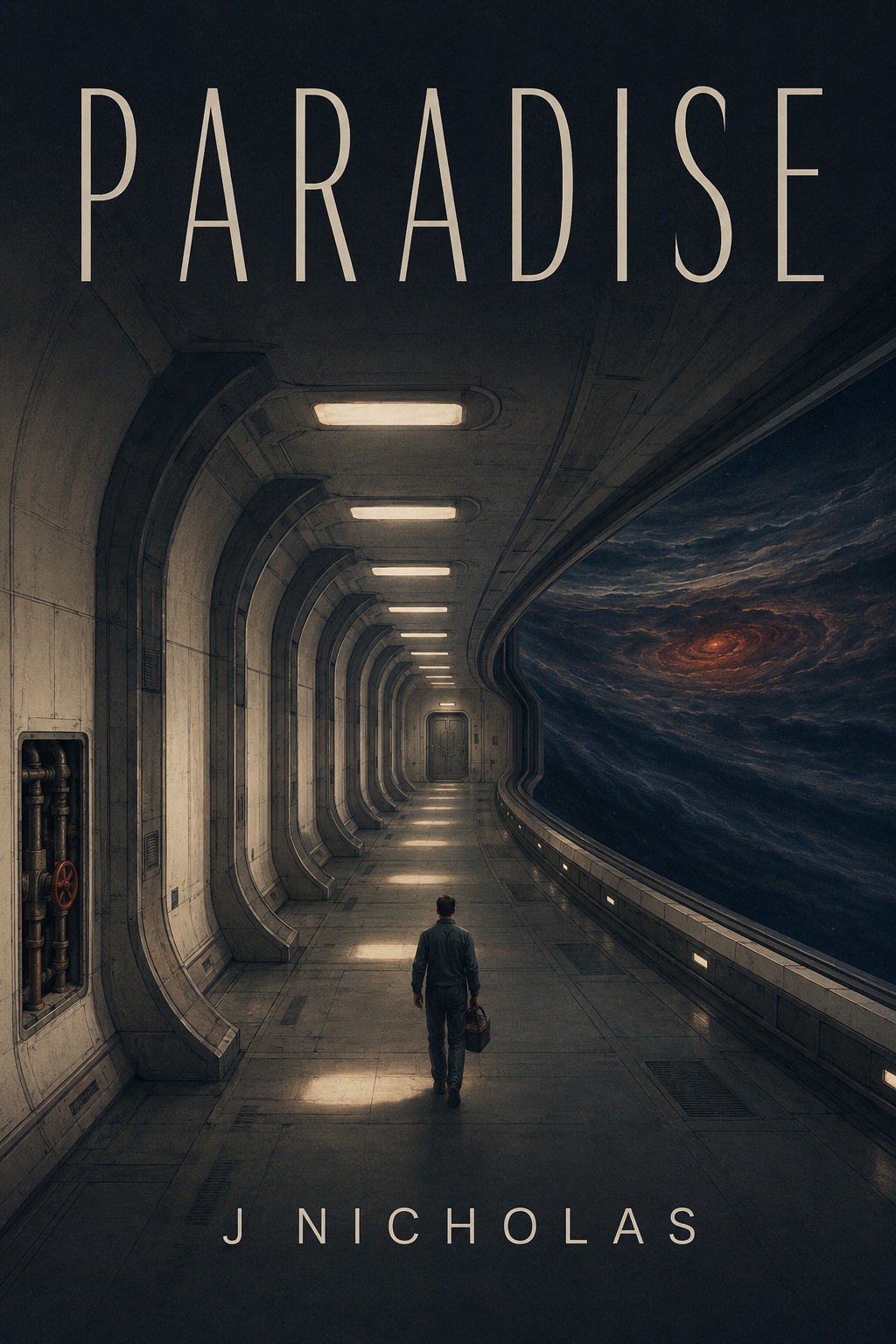
Novel · Standalone
Paradise
J Nicholas
At 22:31, Paradise ends.
Then Marcus wakes at the beginning of the same day.
Marcus Cole is a maintenance technician aboard a station large enough to be a destination and complicated enough to require constant repair. When the station dies, Marcus remembers. Everyone else returns to the morning unchanged.
He learns the day. He tests the station. He follows what repetition makes visible. Each reset restores the world and leaves him alone with what he knows.
Read the opening
Paradise · Opening excerpt
Marcus moved his coffee before the second drop fell.
It struck the table and spread between them.
Thomas looked up from his breakfast.
“No.”
Marcus leaned back in his chair. The ceiling panel above them was dry except for a dark line along one edge.
“I haven’t done anything.”
“You looked at it.”
“It dripped on me.”
“You’re not working.”
Marcus touched the water with one finger. Clear. Cold.
Thomas pushed half a piece of toast into his mouth.
“It could be sewage.”
“It isn’t.”
“You touched it fast.”
“There’s a coolant line above us.”
“Then it could be coolant.”
“It isn’t.”
Thomas looked at him.
His eyebrows had stopped matching years ago. The right rode high over his eye. The left remained nearly level, gray and immovable. The effect made him look amused by things he had already decided were stupid.
Marcus smirked.
Thomas pointed the toast at him.
“There. That. You’ve decided to fix it.”
“I haven’t.”
“You’re smiling.”
“That wasn’t about the leak.”
“What was it about?”
Marcus looked at his coffee.
Thomas waited.
Another drop formed at the seam.
Marcus moved Thomas’s plate.
The drop landed where it had been.
Thomas stared at the empty place in front of him.
“You see?” Marcus said.
“I see a man who can’t eat breakfast without interfering with it.”
The staff commons occupied a broad room off Level Ten, close enough to the guest decks that the walls had been finished and far enough away that no one had bothered hiding the seams. Cream panels covered the conduits. Most sat straight. The one above Marcus had been removed often enough that its corners no longer met.
The tables were fixed to the floor. The chairs were not. Twenty years ago, someone had decided loose chairs made the room feel less institutional. Every few months one migrated into the corridor and maintenance carried it back.
Beyond the galley doors, trays moved through the wash line. Steam gathered against the ceiling. The room smelled of bread, disinfectant and the eggs Thomas distrusted on principle.
The station was Hesperides in Marcus’s work queue and Paradise on the guest maps.
The commons belonged to Hesperides.
The morning lights had not reached full brightness. Night workers occupied the tables nearest the galley. Morning shift gathered near the doors. They traded places without speaking. Uniforms changed. Faces remained the same.
Thomas had been watching them do it for thirty years.
“You eat here every morning,” Marcus said.
Thomas recovered his plate.
“I get hungry every morning.”
“You don’t have a shift.”
“Neither does the galley. Look at them.”
The galley workers were cleaning around the people still eating.
“They have a shift.”
“They have a sentence.”
Marcus drank his coffee.
Thomas scraped the last of his eggs together.
“You could retire somewhere else.”
“I did.”
“This is somewhere else?”
“It was at the time.”
Marcus looked across the room. Thomas had told him three different stories about how he came aboard. In one, Hesperides had needed reactor technicians and Thomas had lied about being one. In another, he had followed a woman whose name changed each time he told it. The third involved a card game and a freight captain with one hand.
Marcus had stopped asking which was true.
Thomas ate the eggs.
“I thought you didn’t trust them.”
“I don’t.”
“That doesn’t stop you?”
“At my age, trust is a luxury.”
Marcus’s wrist terminal vibrated.
Thomas closed his eyes.
“Don’t.”
Marcus looked.
A maintenance ticket had appeared.
COMMONS WEST
CEILING LEAK
PRIORITY 4
“It’s assigned to me.”
“Of course it is.”
“I didn’t file it.”
“The station heard you thinking.”
Marcus opened the ticket. No details. Someone had reported water above Table Six at 06:42.
They were sitting at Table Six.
Thomas leaned across to read it.
“Accurate.”
“It’s probably the drain channel.”
“Probably.”
Marcus looked at him.
The right eyebrow climbed.
Marcus closed the ticket.
Thomas nodded.
“Growth.”
“My shift hasn’t started.”
“More growth.”
They finished breakfast beneath the leak.
More fiction
THE HOFFLEBROCK · J NICHOLAS

